
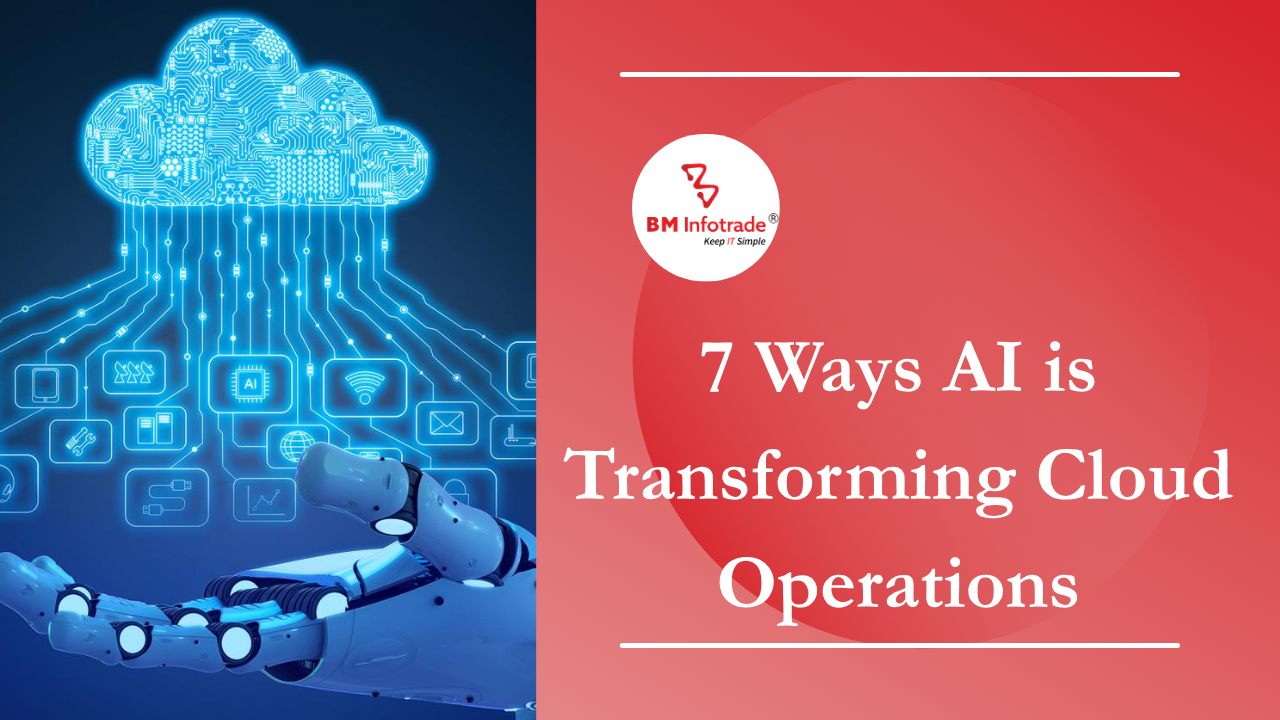
7 Ways AI is Transforming Cloud Operations
Explore seven practical ways AI is revolutionizing cloud operations through predictive scaling, intelligent cost optimization, automated security, compliance monitoring, and multi-cloud orchestration. Learn how AI helps businesses improve uptime, reduce cloud costs, and build resilient cloud infrastructure.
13
Jul
7 Ways AI is Transforming Cloud Operations
Published 13 Jul 2026 Updated 13 Jul 2026 Written and reviewed by Anshul Goyal
Table of Contents
- 1. Predictive Resource Optimization and Auto-Scaling
- 2. Intelligent Cloud Cost Management and Optimization
- 3. Proactive Anomaly Detection and Performance Monitoring
- 4. Enhanced Security Threat Detection and Automated Response
- 5. Automated Incident Response and Root Cause Analysis
- 6. AI-Powered Compliance Monitoring and Auditing
- 7. Intelligent Workload Orchestration and Multi-Cloud Management
- Traditional vs. AI-Enhanced Cloud Operations Architecture
- Implementation Roadmap: From Assessment to Autonomous Operations
- Future-Proofing Your Business
- Success Checklist for AI-Driven Cloud Operations
- Conclusion
- 5 Frequently Asked Questions
Multi-cloud and hybrid environments have brought about unimaginable complexity. Manual monitoring results in reactive firefighting, runaway costs due to over-provisioning, security blind spots and compliance risks that put the uptime and regulatory status at risk. Traditional methods, as determined by our technical staff, just cannot keep up with the dynamic workloads of the day and today average downtime costs any business over 100,000 dollars per hour and inefficient resource allocation that is a waste of money; consuming 30-35 percent of cloud budgets in many businesses.
Since Solution Architects were concerned with the technical reliability and scalability, we have deployed AI in dozens of client environments. The findings are similar: AI moves operations to be autonomous as opposed to reactive and deals directly with these pain points, which correspond to the global standards of the AWS Well-Architected Framework, Kubernetes orchestration, ISO 27001, SOC 2, or the NIST Cybersecurity Framework.
1. Predictive Resource Optimization and Auto-Scaling
AI is able to analyze historical trends, real time measurements, and external indicators to predict demand and automatically scale up and down compute, storage and network resources. In terms of implementation, machine learning models with Kubernetes clusters avoid over-provisioning and ensure that there is no performance loss.
Real-world example: AWS predictive scaling customers have seen a decrease in idle resources through the dynamically right-sizing of instances in advance of demand spikes. Case studies indicate a regular increase in responsiveness with no human involvement.
2. Intelligent Cloud Cost Management and Optimization
The usage data, pricing models and workload patterns are continuously scanned by AI, which suggests rightsizing, reserved instances, and optimal scheduling. Our solutions apply AI to a native cloud toolsets to provide real-time adaptive recommendations.
Real case: Using cost analytics based on AI, organizations have discovered and removed waste in multi-cloud contexts, which makes their monthly spending measurably lower, without any impact to their performance.
3. Proactive Anomaly Detection and Performance Monitoring
The conventional threshold based monitoring creates alert fatigue. AI puts in place adaptive baselines and cross-service correlation of metrics to identify actual anomalies at early stages.
Live case study: AIOps systems have helped IT departments to forecast when their systems are degraded before users are affected, providing root-cause insights within minutes, not hours.
4. Enhanced Security Threat Detection and Automated Response
AI compares configurations, access logs, and network traffic with NIST Cybersecurity Framework controls to detect threats that are not detected by rule-based systems.
The organization can achieve compliance with ISO 27001 and SOC 2 processes through their established security procedures. Financial institutions that implement AI-powered cloud security solutions (such as those using AWS-based anomaly detection) have achieved shorter threat response times and reduced false positive rates.
5. Automated Incident Response and Root Cause Analysis
The AI system receives logs, traces, and metrics data which it uses to identify the main causes of problems and start software procedures that usually solve issues before they become visible through manual observation. The engineering teams developed this system to accomplish automatic handling of security incidents without any need for human intervention in live operational environments.
6. AI-Powered Compliance Monitoring and Auditing
AI automates gathering of evidence, implementation of policies and reporting of audit on ISO 27001, SOC 2 and others.
Periodic, manual audits are substituted with continuous monitoring.
Real world scenario: Organizations have been able to have always-on compliance at a lower administrative overhead so that they are always regulatory ready.
7. Intelligent Workload Orchestration and Multi-Cloud Management
AI considers the latency, cost, compliance and performance to distribute workloads in the optimal locations on AWS, Azure and Kubernetes.
This facilitates an easy migration and hybrid operations.
Live case: Business has simplified the use of multi-clouds to enhance user experience, and address the data-sovereignty demands.
Traditional vs. AI-Enhanced Cloud Operations Architecture
| Aspect | Traditional Method | Our AI-Enhanced IT Solution |
|---|---|---|
| Resource Scaling | Reactive, rule-based auto-scaling | Predictive ML models + Kubernetes orchestration |
| Cost Management | Periodic manual reviews | Real-time AI recommendations aligned with AWS Well-Architected Framework |
| Security & Threat Detection | Static rules and periodic scans | Continuous AI analysis per NIST Cybersecurity Framework |
| Incident Response | Manual triage and root-cause analysis | Automated detection, analysis, and remediation |
| Compliance Auditing | Quarterly manual evidence collection | Continuous monitoring for ISO 27001 & SOC 2 |
| Workload Placement | Static provisioning | AI-driven intelligent orchestration across multi-cloud |
Implementation Roadmap: From Assessment to Autonomous Operations
1. Discovery & Assessment (2-4 weeks): The process involves mapping the existing cloud infrastructure of the organization while identifying high-impact use cases that will be assessed against the Well-Architected AWS framework.
2. Pilot Deployment (4-6 weeks): Deploy AI in one area (e.g., cost optimization or security) to non-production environment.
3. Integration & Training (6-8 weeks): Integrate with the current Kubernetes, monitoring and IAM systems; educate the teams on AI supervision.
4. Scale & Optimize (Continuous): Implement enterprise-wide with governance, retraining of models continually and KPI monitoring.
5. Governance & Review: Have quarterly architecture reviews to ensure that we are in line with ISO 27001, SOC 2 and NIST.
Future-Proofing Your Business
AI-native operations guarantee that your infrastructure is adapted to the demand and regulatory changes, as well as emergent threats. With intelligence at all levels and without compromising on the global standards, organizations can have sustainable scalability and resilience.
Success Checklist for AI-Driven Cloud Operations
● Perform a complete cloud maturity analysis with AWS Well-Architected Framework.
● Find 2 high ROI use cases (cost, security or scaling).
● Implement AI in a managed Kubernetes or container solution.
● Fit in with other compliance standards (ISO 27001, SOC 2, NIST).
● Put in place automated warning and human-in-the-loop monitoring.
● Compare pre-implementation and post-implementation of measure baseline KPIs (cost, uptime, MTTR).
● Arrange retraining and review of AI models and architecture every quarter.
Conclusion
AI is now indispensable to cloud operations- it is the backbone to reliable, scalable and secure infrastructure. Our technical teams have always achieved tangible results through their integration of intensive engineering and solutions based on standards using AI. By taking action today, organizations will be in a position of having a long-term competitive advantage.
5 Frequently Asked Questions
1. How quickly can AI deliver ROI in cloud operations?
The majority of clients experience cost reductions and uptime improvements within 8-12 weeks of pilot deployment with complete ROI normally achieved in 4-6 months.
2. Does AI replace our existing cloud team?
No. AI complements your team by doing the repetitive work and enables engineers to work on strategy, architecture and innovations.
3. How do you ensure security and compliance when implementing AI?
Every solution has been developed to be compatible with ISO 27001, SOC 2 and NIST Cybersecurity Framework controls and comes with complete audit trails and human management.
4. Is this suitable for multi-cloud or hybrid environments?
Yes. We have cloud-agnostic architecture and are optimized with AWS, Azure and Kubernetes deployments.
5. What technical prerequisites are required?
Simple observability infrastructure, container orchestration (Kubernetes) and cloud billing/monitoring API access. The remainder we do at implementation.
Anshul Goyal
Group BDM at B M Infotrade | 11+ years Experience | Business Consultancy | Providing solutions in Cyber Security, Data Analytics, Cloud Computing, Digitization, Data and AI | IT Sales Leader