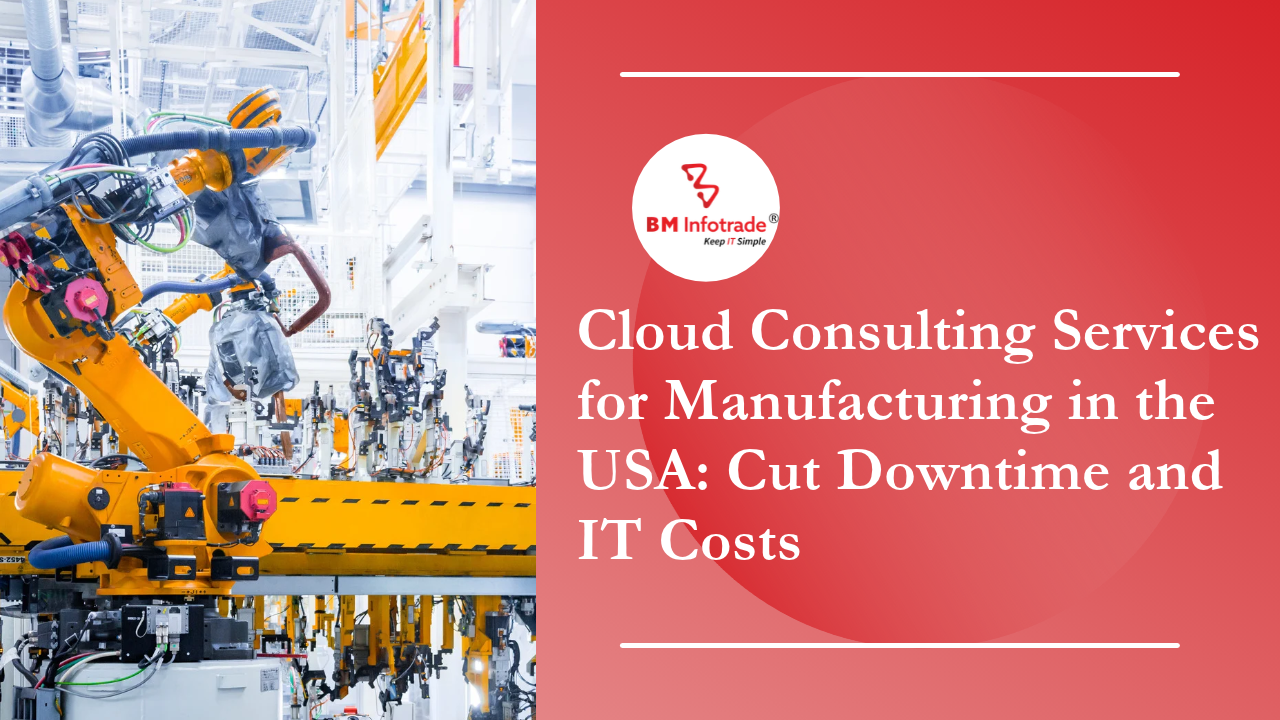
Cloud Consulting Services for Manufacturing in the USA: Cut Downtime and IT Costs
Cloud consulting services for manufacturing help US plants assess, migrate, secure, and optimize the cloud, edge, and operational technology (OT) systems behind production. The goal is fewer unplanned stoppages, lower IT spend, and faster, data-driven decisions. BM Infotrade covers the full path in one engagement: cloud migration, backup and disaster recovery, data and AI, a Security Operations Centre (SOC), and VAPT.
26
Oct
Cloud Consulting Services for Manufacturing in the USA: Cut Downtime and IT Costs
Published 26 Oct 2026 Updated 26 Oct 2026 Written and reviewed by Anshul Goyal
Table of Contents
- Key facts at a glance
- TL;DR for busy plant and IT leaders
- What are cloud consulting services for manufacturing?
- Why are US manufacturers moving to the cloud now?
- How does cloud consulting reduce manufacturing downtime?
- How does cloud consulting reduce manufacturing IT costs?
- Is cloud, on-premises, or hybrid best for a US manufacturer?
- Which US security and compliance standards matter for manufacturing cloud projects?
- How do you move a manufacturing operation to the cloud? A 7-step roadmap
- How do you choose a cloud consulting partner for manufacturing?
- Why is BM Infotrade a strong cloud consulting partner for US manufacturers?
- What are the benefits, limits, and common mistakes of manufacturing cloud consulting?
- Where is cloud consulting used in US manufacturing?
- What does a manufacturing cloud project look like? (Illustrative example)
- Frequently asked questions
- What are cloud consulting services for manufacturing?
- How does cloud computing reduce manufacturing downtime?
- Can predictive maintenance prevent equipment failure?
- Is cloud computing suitable for OT and plant-floor systems?
- Is hybrid cloud better for manufacturing?
- How does cloud migration reduce IT costs?
- How long does manufacturing cloud migration take?
- How much do manufacturing cloud consulting services cost in the USA?
- Which cloud platforms do US manufacturers use?
- Do US manufacturers need CMMC compliance for cloud systems?
- How should manufacturers calculate cloud ROI?
- Why choose BM Infotrade for manufacturing cloud consulting?
- Conclusion: start with the assessment, not the migration
- Talk to BM Infotrade about a manufacturing cloud assessment
Definition: Manufacturing cloud consulting is the assessment, design, migration, integration, security, and ongoing optimization of the cloud infrastructure and applications used in production, including ERP, MES, SCADA data, industrial IoT, and analytics.
Most US manufacturers do not need to move everything to the cloud. They need to decide what belongs in the cloud, what belongs at the edge, and what must stay on the plant floor, then do it without interrupting production. That decision is the real work of a manufacturing cloud consultant.
Key facts at a glance
- The stakes are large. US manufacturing adds $3.00 trillion in value, or 9.4% of GDP (Q2 2026), and employs 12.6 million people across more than 239,000 manufacturers, according to the National Association of Manufacturers.
- Cloud can cut downtime. A Hackett Group study of 600 organizations, published by AWS in March 2023, found unexpected IT downtime fell 39% and unexpected manufacturing downtime fell 36% after migration.
- Hybrid usually wins. Latency-sensitive control systems stay local, while analytics, backup, and AI scale in the cloud.
- Security and compliance are part of the design. In the US that means NIST SP 800-82 Rev. 3 for OT security and, for defense suppliers, CMMC.
- Cost control is a discipline. Moving servers does not save money by itself. FinOps governance does.
TL;DR for busy plant and IT leaders
- Start with the cost of one hour of downtime on your most critical line.
- Pilot on one bottleneck, such as predictive maintenance or backup, before any plant-wide move.
- Use hybrid and edge architecture for real-time machine control.
- Treat OT security, NIST alignment, and CMMC readiness as design inputs, not afterthoughts.
- Choose one partner that covers cloud, data, and security together, so nothing falls between vendors.
What are cloud consulting services for manufacturing?
Cloud consulting services for manufacturing are advisory and implementation services that help a factory decide which systems to move to the cloud, how to connect them to plant-floor equipment, and how to keep production secure and compliant. They combine cloud architecture, OT and IT integration, data engineering, security, and cost governance.
A manufacturing cloud consultant typically works across:
- ERP and supply chain systems
- Manufacturing execution systems (MES)
- SCADA, PLC, and data historian data
- Industrial IoT sensors and edge gateways
- Product lifecycle management (PLM), CAD, and CAE applications
- Quality management systems
- Production databases and data warehouses
- Analytics, AI, and machine learning
- Backup and disaster recovery
How is it different from regular IT cloud migration?
A factory cannot be treated like an office. Production lines run in real time, equipment has a long life, downtime is expensive, and a security mistake can affect physical safety. That is why manufacturing cloud projects start with plant requirements and use hybrid or edge architecture, rather than a blanket "lift and shift".
What does a good engagement deliver?
- A current-state assessment of IT, OT, data flows, security, and licensing
- A workload-by-workload decision: migrate, modernize, replace, keep on-premises, or retire
- A target architecture (public, private, hybrid, or edge)
- A phased migration plan with tested rollback
- Backup and disaster recovery designed around your recovery time objectives
- Security controls aligned to US standards
- A FinOps model that ties cloud spend to plants and business outcomes
Key takeaway: The best manufacturing cloud consulting is measured in uptime, cost per unit, and decision speed. It is not measured in servers migrated.
Why are US manufacturers moving to the cloud now?
US manufacturers are moving to the cloud because unplanned downtime is expensive, legacy systems block data and AI, and security expectations keep rising. Cloud and edge platforms give plants one governed place to collect machine data, analyze it, and act on it.
The cost of downtime is the clearest driver. Siemens' True Cost of Downtime 2024 report found:
- Fortune Global 500 companies lose about $1.4 trillion a year to unplanned downtime, equal to 11% of their revenues.
- Automotive manufacturers lose $2.3 million for every unproductive hour.
- Almost half of surveyed firms now have predictive maintenance teams, twice the share seen in 2019, and 87% already gather data that makes predictive maintenance possible.
The last point matters. Most plants already produce the data. What they lack is a way to bring it together and act on it.
The five pressures behind cloud adoption
- Downtime exposure. One failed line can erase a week of savings.
- Aging infrastructure. Old servers, legacy ERP, and local backups are costly to maintain and slow to recover.
- Data silos. Machine, maintenance, quality, and ERP data sit in separate systems, so analytics and AI stall.
- Multi-plant visibility. Leaders in Detroit, Houston, or Atlanta cannot compare plant performance if every site reports differently.
- Cyber and compliance risk. OT security guidance such as NIST SP 800-82 Rev. 3 and defense-supplier rules push manufacturers to modernize their security architecture at the same time.
Whether your plants sit in the Midwest, the Southeast automotive corridor, or the Texas Gulf Coast, the pattern is the same. The winners connect operational data to a governed cloud platform, keep time-critical control local, and measure results in avoided downtime.
How does cloud consulting reduce manufacturing downtime?
Cloud consulting reduces manufacturing downtime by connecting machine and maintenance data, spotting equipment problems before they become failures, shortening root-cause analysis, and making recovery faster when systems do fail. It does not remove every breakdown. It moves your team from reacting to planning.
In the Hackett Group study cited earlier, manufacturers saw a 36% reduction in unexpected manufacturing downtime after moving to the cloud. Results vary by plant, but the mechanisms are consistent.
1. Predictive maintenance
Predictive maintenance uses equipment data to detect abnormal behavior before a machine fails. Sensors continuously collect:
- Temperature and pressure
- Vibration and acoustic signals
- Motor current and RPM
- Cycle time and energy consumption
Cloud analytics and machine learning models learn what normal looks like and flag drift. Maintenance can then be scheduled in a planned window rather than during a production run.
2. Centralized multi-plant monitoring
One dashboard can track equipment availability, OEE, production rates, alarm frequency, maintenance history, quality metrics, and energy use across every plant. A problem at a facility in another state is visible in minutes, not at the next weekly report.
3. Faster root-cause analysis
When OT and IT data live in one platform, teams can correlate PLC events, sensor readings, maintenance records, production batches, operator actions, and inspection results. That turns "the line stopped" into "here is why, and here is what changed."
4. Stronger backup and disaster recovery
Critical databases and applications can be replicated to a separate cloud region, so a server, storage, or site failure does not mean days of recovery. The design should be built around two numbers:
- Recovery time objective (RTO): how quickly a system must be back.
- Recovery point objective (RPO): how much data you can afford to lose.
Critical plant systems must still be able to run locally if the internet connection drops.
Metrics to track
- Unplanned downtime hours per line
- Mean time to repair (MTTR) and mean time between failures (MTBF)
- OEE
- Maintenance cost per asset
- Recovery time in disaster recovery tests
How does cloud consulting reduce manufacturing IT costs?
Cloud consulting reduces IT costs by finding waste, right-sizing resources, replacing hardware refresh cycles with pay-for-use capacity, and putting cost governance in place. Simply migrating servers does not save money automatically. A consultant first studies how each workload behaves, then decides where the cloud is cheaper and where it is not.
Typical savings areas:
|
Cost area |
Common on-premises challenge |
Cloud consulting approach |
|---|---|---|
|
Servers |
Large upfront capital spend |
Right-sized cloud resources |
|
Storage |
Capacity bought years ahead |
Storage that grows with demand, with lifecycle tiers |
|
Backup |
Extra hardware and tape handling |
Cloud backup tiers |
|
Disaster recovery |
A secondary site that sits idle |
Replicated cloud environment, paid for when used |
|
Software |
Unused or duplicate licenses |
License assessment and optimization |
|
Maintenance |
Hardware refresh and break-fix cycles |
Managed infrastructure |
|
Analytics |
Dedicated systems for each report |
Scalable analytics services |
|
Testing |
Permanent test servers |
Temporary on-demand environments |
Keep cloud spending under control with FinOps
Cloud flexibility can become cloud overspend without governance. The FinOps Foundation describes FinOps as an operating model that brings engineering, finance, procurement, and business teams together to manage cloud value. For a manufacturer, a practical FinOps setup includes:
- Resource tagging by plant, line, and department
- Cost allocation and monthly review by plant
- Budget alerts
- Reserved or committed capacity where usage is steady
- Storage lifecycle policies and removal of unused resources
- Scheduled shutdown of non-production workloads
Measure cost per outcome, not the cloud bill
A lower invoice is not the goal. Track:
- Cloud cost per plant
- IT cost per unit produced
- Maintenance cost per asset
- Downtime cost avoided
- Cost per analytics workload
These numbers make the return on investment visible to your CFO and plant managers.
Is cloud, on-premises, or hybrid best for a US manufacturer?
Hybrid cloud is usually the most practical choice for manufacturers, because plants need cloud scalability for analytics and recovery, and local reliability for real-time production. Public cloud suits analytics, backup, and enterprise applications. On-premises or edge systems suit millisecond-sensitive control and sites with unreliable connectivity.
|
Factor |
On-premises |
Public cloud |
Hybrid cloud |
|---|---|---|---|
|
Upfront cost |
High |
Lower |
Medium |
|
Scalability |
Limited |
Excellent |
Excellent |
|
Local control |
Excellent |
Limited |
Excellent |
|
AI and analytics |
More complex to build |
Excellent |
Excellent |
|
Low-latency OT |
Excellent |
Depends on connectivity |
Excellent |
|
Disaster recovery |
Expensive |
Strong |
Strong |
|
Legacy equipment integration |
Strong |
More difficult |
Strong |
|
Overall fit for manufacturing |
Moderate |
Depends on the use case |
Often strongest |
When should you use edge computing?
Use edge computing when a machine needs a decision faster than a round trip to the cloud allows, or when a plant must keep running during an internet outage. The edge processes time-critical data locally and sends summaries and selected data to the cloud for analytics and long-term storage.
A simple rule for placing workloads
- Keep local: real-time control, safety systems, and anything that must run through a network failure.
- Move to the cloud: backup, disaster recovery, analytics, reporting, collaboration, test environments, and most enterprise applications.
- Split across both: machine data collection, quality inspection, and predictive maintenance.
Which US security and compliance standards matter for manufacturing cloud projects?
The standards that matter most depend on what you make and who you sell to. Every US manufacturer should design around NIST guidance for OT security. Defense suppliers add NIST SP 800-171 and CMMC. Exporters of controlled technology add ITAR or EAR rules, and FDA-regulated plants add electronic-records rules.
|
Framework |
Who it applies to |
What it means for a cloud design |
|---|---|---|
|
Operators of OT and industrial control systems |
Segment IT from OT, protect safety and availability first, monitor OT networks |
|
|
NIST Cybersecurity Framework 2.0 |
Any organization |
Organize security by govern, identify, protect, detect, respond, and recover |
|
IEC 62443 |
Industrial automation and control systems |
Define security zones and conduits between plant-floor systems |
|
NIST SP 800-171 and DFARS 252.204-7012 |
Defense suppliers handling controlled unclassified information (CUI) |
Define the CUI boundary, apply the 110 controls, report incidents |
|
CMMC (32 CFR Part 170) |
Defense contractors and subcontractors |
See the current status below |
|
ITAR and EAR |
Makers of export-controlled products and technical data |
Control who can access data and where it is stored |
|
FDA 21 CFR Part 11 |
FDA-regulated manufacturers |
Audit trails, access control, and validated electronic records |
Check your specific obligations with your compliance counsel. A consultant's job is to build an architecture that makes those obligations easier to meet.
CMMC status as of October 26, 2026
On July 13, 2026, the Department of War suspended CMMC Phase II, which would have started on November 10, 2026 and made third-party Level 2 assessments the default for contracts involving CUI. A reform task force was asked to review the program. As of October 22, 2026, one industry summary reports no announced task-force outcome or new Phase II date.
What still applies, according to Secureframe's tracker:
- Phase 1 self-assessment requirements
- DFARS 252.204-7012 safeguarding and incident reporting, which requires NIST SP 800-171
- Submitting your score to SPRS, with an annual executive affirmation
- Flow-down of requirements from prime contractors
- False Claims Act exposure for misstating compliance
The suspension removes a deadline, not the standard. Defense suppliers should keep building toward Level 2 readiness, and confirm the latest status with official Department of War sources before relying on any date.
Security basics every manufacturing cloud design needs
- Network segmentation between IT, OT, and cloud, with controlled gateways.
- Zero-trust access: least privilege and multi-factor authentication for remote and vendor access.
- Encryption of data at rest and in transit.
- Centralized logging and 24x7 monitoring through a Security Operations Centre (SOC).
- Independent testing with VAPT (vulnerability assessment and penetration testing) before and after go-live.
- Tested backups that stay isolated from production, to withstand ransomware.
How do you move a manufacturing operation to the cloud? A 7-step roadmap
A safe manufacturing cloud transformation follows seven steps: assess, prioritize, classify workloads, design, pilot, migrate in phases, and optimize. It starts from operational needs, not from a technology choice.
- Assess the current environment. Inventory applications, servers, ERP, MES, SCADA, databases, networks, IoT devices, OT systems, data flows, security controls, licenses, and current IT spend.
- Output: a baseline of cost, risk, and dependencies.
- Map business priorities. Rank outcomes such as less downtime, lower infrastructure cost, plant visibility, ERP modernization, disaster recovery, predictive maintenance, and AI readiness.
- Output: a business case that uses your hourly downtime cost.
- Classify every workload. Decide to migrate, modernize, replace, retain on-premises, or retire. Not every manufacturing workload belongs in a public cloud.
- Output: a workload decision register.
- Design the target architecture. Choose public, private, hybrid, multi-cloud, or edge, and define network, identity, security, backup, and data design.
- Output: an architecture and a security model.
- Run a pilot. Start with one contained use case, such as backup, equipment monitoring, a non-critical application, or predictive maintenance on a single line.
- Output: measured results and lessons learned.
- Migrate in phases. Move production-critical systems during planned maintenance windows, with tested rollback plans and OT teams involved.
- Output: a cutover plan for each wave, with rollback criteria.
- Optimize continuously. Track availability, cloud cost, performance, downtime, MTTR, maintenance cost, OEE, and security events, then tune.
- Output: a monthly review that links cloud spend to plant outcomes.
How long does manufacturing cloud migration take?
It depends on application complexity, number of plants, integration needs, security controls, and scope. A focused pilot can be completed relatively quickly. An enterprise-wide, multi-plant program is usually phased over a longer period, with each wave tied to a measurable outcome.
How do you choose a cloud consulting partner for manufacturing?
Choose a partner that understands production as well as IT, covers cloud, data, and security together, ties its work to measurable outcomes, and stays involved after go-live. A vendor that only migrates servers will leave the hardest manufacturing problems unsolved.
|
What to look for |
Question to ask |
What a good answer sounds like |
|---|---|---|
|
OT and IT awareness |
How do you handle PLCs, SCADA, and historians during migration? |
Hybrid and edge by default, with OT teams in the plan |
|
One accountable team |
Who owns cloud, data, and security? |
One partner across all three, not three handoffs |
|
Security by design |
When is security tested? |
Before and after go-live, with SOC monitoring and VAPT |
|
Cost governance |
How will you control cloud spend? |
FinOps from day one, cost tracked by plant |
|
Measurable outcomes |
What will we measure? |
Downtime hours, MTTR, cost per unit, recovery time |
|
Recovery readiness |
How do you prove recovery works? |
Regular failover tests against agreed RTO and RPO |
|
Compliance fit |
How do you support NIST and defense requirements? |
Architecture mapped to your frameworks, with evidence |
|
Support after go-live |
Who runs it next year? |
Ongoing monitoring and optimization |
Why is BM Infotrade a strong cloud consulting partner for US manufacturers?
BM Infotrade is an IT solutions company that helps businesses modernize, secure, and scale their technology across Cloud, Data and AI, Cyber Security, and Digitization. For manufacturers, the value is simple: one accountable partner covers the whole journey, from the first assessment to monitoring after go-live.
- Cloud migration done in phases. Cloud migration services built around workload decisions, pilots, and tested rollback, not a blanket lift and shift.
- Recovery you can rely on. Backup and disaster recovery designed around your recovery time and recovery point objectives.
- Data and AI ready. Data warehouse and analytics that turn machine, maintenance, and ERP data into predictions you can act on.
- Security built in. A Security Operations Centre for continuous monitoring and VAPT to find weaknesses before attackers do. Security is part of the design, not a separate purchase.
- International delivery experience. BM Infotrade serves customers across the UK, Latin America and the Caribbean (LAC), Saudi Arabia, and Africa.
- Plain-language approach. The company's promise is to Keep IT Simple: clear scope, clear milestones, and clear business metrics.
The best first step: a manufacturing cloud assessment
BM Infotrade starts with an assessment of your IT and OT environment, your downtime exposure, and your cloud costs. You receive a prioritized roadmap showing what to migrate, what to keep local, and what each move is expected to save. Request a manufacturing cloud assessment.
What are the benefits, limits, and common mistakes of manufacturing cloud consulting?
When it is tied to specific plant goals, cloud consulting delivers better reliability, scalability, cost visibility, and data access. It also adds new dependencies, so risks need planning before migration.
Main benefits
- Fewer unplanned stoppages through predictive maintenance and monitoring
- Lower infrastructure and maintenance costs
- Faster, more reliable disaster recovery
- One view of every plant
- Faster rollout of analytics and AI
- Less data trapped in silos
- Easier collaboration across plants, suppliers, and engineering teams
Limitations and challenges
- Legacy equipment that is hard to connect
- Unreliable connectivity at some plants
- Migration complexity and production risk
- Vendor lock-in
- Cloud cost overruns without governance
- Data residency and export-control requirements
- OT cybersecurity risk
- Skills shortages on the plant IT team
- Latency-sensitive workloads that cannot depend on a remote data center
Seven mistakes to avoid
- Moving every workload to the cloud
- Migrating without mapping dependencies
- Leaving OT and plant engineers out of the plan
- Underestimating cybersecurity
- Cutting over during critical production periods
- Skipping tested rollback procedures
- Buying cloud capacity with no FinOps governance
Two more traps are worth naming: building yet another isolated data platform, and deploying AI before fixing data quality. If analytics is your goal, start with clean, connected data. Our guide to predictive analytics consulting explains how.
Best practices
- Build the business case first, using your downtime cost.
- Assess IT and OT together.
- Prioritize the highest-cost downtime problems.
- Use edge computing where latency matters.
- Apply zero-trust access and encrypt sensitive data.
- Segment OT and IT networks.
- Test disaster recovery regularly.
- Put FinOps in place from day one.
- Define measurable KPIs and train internal teams.
Four expert tips
- Calculate downtime cost first. Work out the cost of one hour on each critical line. It tells you where to invest.
- Start with one bottleneck. A successful pilot on a high-value machine beats a plant-wide program with unclear goals.
- Keep time-critical decisions close to the machine. Do not route millisecond-sensitive control through a distant data center.
- Measure unit economics. Cloud cost per plant, IT cost per unit, maintenance cost per asset, and downtime cost avoided make ROI easy to defend.
Where is cloud consulting used in US manufacturing?
Cloud consulting is used wherever production data, uptime, and compliance meet. AWS, Microsoft Azure, and Google Cloud all publish manufacturing reference architectures that link edge devices and industrial systems to cloud analytics, and the same pattern repeats across sectors:
- Automotive and tier-1 suppliers: line-level downtime monitoring, predictive maintenance on CNC and press equipment, and supplier data integration.
- Aerospace and defense: secure enclaves for controlled data, with architecture aligned to NIST SP 800-171.
- Food and beverage: traceability, cold-chain monitoring, and fast recovery for scheduling and ERP systems.
- Medical devices and pharmaceuticals: validated systems, audit trails, and compliant electronic records.
- Industrial equipment and metals: asset health analytics, energy monitoring, and multi-plant reporting.
- Electronics: quality inspection data, yield analysis, and test-data storage.
What does a manufacturing cloud project look like? (Illustrative example)
This is a hypothetical scenario for illustration only. It does not describe a real client engagement.
Imagine a mid-sized US manufacturer with three plants and frequent CNC machine failures. Each plant runs its own servers, its own maintenance database, and its own machine monitoring.
The problem
- Frequent unplanned machine outages
- No visibility across plants
- High server maintenance costs
- Reactive maintenance only
- No central analytics
The approach
- Assess IT and OT infrastructure and calculate the cost of an hour of downtime per line.
- Keep machine control systems local.
- Connect machine telemetry through secure edge gateways.
- Send selected data to a cloud analytics platform and build equipment-health dashboards.
- Create predictive-maintenance models for the highest-cost machines first.
- Move backup and disaster recovery to the cloud.
- Add FinOps controls, SOC monitoring, and a VAPT before go-live.
The expected outcome
Instead of discovering a spindle problem after it fails, the maintenance team receives an anomaly alert and schedules service between production runs. The value comes from avoided disruption and better planning, not from swapping a local server for a cloud server.
Frequently asked questions
What are cloud consulting services for manufacturing?
They are advisory and implementation services that help manufacturers assess, design, migrate, secure, and optimize cloud infrastructure for ERP, MES, IoT, analytics, databases, disaster recovery, and plant data. The aim is less downtime, lower IT cost, and better decisions.
How does cloud computing reduce manufacturing downtime?
It provides centralized equipment monitoring, predictive maintenance, machine-data analytics, faster root-cause analysis, automated alerts, and stronger disaster recovery. A Hackett Group study of 600 organizations reported 36% less unexpected manufacturing downtime after cloud migration.
Can predictive maintenance prevent equipment failure?
It cannot prevent every failure, but it can detect abnormal patterns in sensor and equipment data early. Maintenance teams can then act in a planned window instead of after a breakdown.
Is cloud computing suitable for OT and plant-floor systems?
Cloud works well for OT analytics, data management, and backup. Real-time and safety-critical control should stay local or at the edge, because it cannot depend on internet connectivity or round-trip latency.
Is hybrid cloud better for manufacturing?
For most manufacturers, yes. Hybrid keeps critical production systems local while using the cloud for scalable storage, analytics, AI, collaboration, and disaster recovery.
How does cloud migration reduce IT costs?
Savings come from less hardware, right-sizing, better utilization, lower disaster-recovery infrastructure, automated management, license optimization, and retiring obsolete applications. FinOps governance keeps the savings from disappearing into overspend.
How long does manufacturing cloud migration take?
It depends on application complexity, number of plants, integration needs, security controls, and scope. A focused pilot can be done relatively quickly, while multi-plant modernization is usually phased over a longer period.
How much do manufacturing cloud consulting services cost in the USA?
Pricing depends on scope: number of plants, workloads, integrations, security requirements, and whether you want ongoing managed support. A fixed-scope assessment is the usual first step because it turns an open-ended project into a priced roadmap.
Which cloud platforms do US manufacturers use?
Common choices are Amazon Web Services, Microsoft Azure, and Google Cloud, combined with industry ERP, MES, IoT, edge, and analytics tools. Regulated manufacturers may also need government-grade cloud regions.
Do US manufacturers need CMMC compliance for cloud systems?
Only defense suppliers that handle controlled unclassified information. As of October 2026, CMMC Phase II is suspended, but NIST SP 800-171, DFARS 252.204-7012, and SPRS reporting still apply. Confirm the latest status with official Department of War sources.
How should manufacturers calculate cloud ROI?
Compare infrastructure savings, maintenance savings, productivity gains, avoided downtime, lower disaster-recovery cost, license changes, and labor savings against cloud operating costs over a defined period, such as three years.
Why choose BM Infotrade for manufacturing cloud consulting?
BM Infotrade offers cloud migration, backup and disaster recovery, data warehouse and analytics, a Security Operations Centre, and VAPT in one engagement. That means one accountable partner, security built into the design, and a roadmap tied to downtime and cost outcomes.
Conclusion: start with the assessment, not the migration
Cloud consulting pays off for US manufacturers when it is tied to plant outcomes: fewer unplanned stoppages, lower infrastructure cost, safer OT, and faster decisions from connected data. The path is rarely all-cloud. It is a hybrid design that keeps time-critical control local and uses the cloud for analytics, backup, and scale.
Key takeaways
- Calculate your hourly downtime cost first, then prioritize the lines where it is highest.
- Pilot one bottleneck before scaling across plants.
- Use hybrid and edge architecture for real-time machine control.
- Design OT security and compliance in from the start, including NIST SP 800-82 and, for defense suppliers, NIST SP 800-171.
- Put FinOps in place on day one so savings are real.
- Pick one partner that covers cloud, data, and security together.
Talk to BM Infotrade about a manufacturing cloud assessment
If unplanned downtime, rising IT cost, or security and compliance pressure is slowing your plants, the best first step is a cloud assessment. BM Infotrade will review your IT and OT environment, identify the migrations with the clearest return, and give you a roadmap with expected cost and downtime impact.
Request your manufacturing cloud assessment
Anshul Goyal
Group BDM at B M Infotrade | 11+ years Experience | Business Consultancy | Providing solutions in Cyber Security, Data Analytics, Cloud Computing, Digitization, Data and AI | IT Sales Leader