IT Infrastructure for Multi-Plant Manufacturers: SD-WAN vs MPLS Cost
Discover how SD-WAN and MPLS compare in cost, performance, reliability, and scalability for multi-plant manufacturing businesses. Learn which network infrastructure offers better connectivity and cost efficiency across multiple facilities.
12
Nov
IT Infrastructure for Multi-Plant Manufacturers: SD-WAN vs MPLS Cost
Published 12 Nov 2026 Updated 12 Nov 2026 Written and reviewed by Anshul Goyal
Table of Contents
- Introduction
- Is SD-WAN Cheaper Than MPLS?
- Why WAN Infrastructure Matters for Multi-Plant Manufacturers
- What Is MPLS?
- What Is SD-WAN?
- SD-WAN vs MPLS Cost Comparison
- What Makes MPLS Expensive for Manufacturers?
- How SD-WAN Can Reduce Network Costs
- Manufacturing Use Cases
- Step-by-Step: How to Compare SD-WAN vs MPLS Cost
- Benefits of SD-WAN for Multi-Plant Manufacturers
- Limitations and Risks
- Underestimating migration costs
- FAQs
- Conclusion
Introduction
For organisations with multiple plants, warehouses, distribution centres, and offices, the wide area network does not act merely as an IT network but rather as a connectivity layer that supports anything from manufacturing processes, ERP operations, supply chains, cloud services, and IoT devices to communications among different sites.
In the debate about SD-WAN vs MPLS costs, MPLS guarantees predictable links and good performance, although it can get expensive over time due to dedicated lines that are needed as both the bandwidth request and the number of locations grow. In contrast, SD-WAN can make use of different transport technologies, from broadband internet to LTE/5G connections to MPLS, and at the same time manage the traffic efficiently from one location.
In most cases, replacing MPLS with SD-WAN is neither a necessary nor a feasible solution for multi-plant manufacturers. Instead, a hybrid solution can be used that maintains MPLS for the most important traffic while switching to the cheaper internet services for everything else.
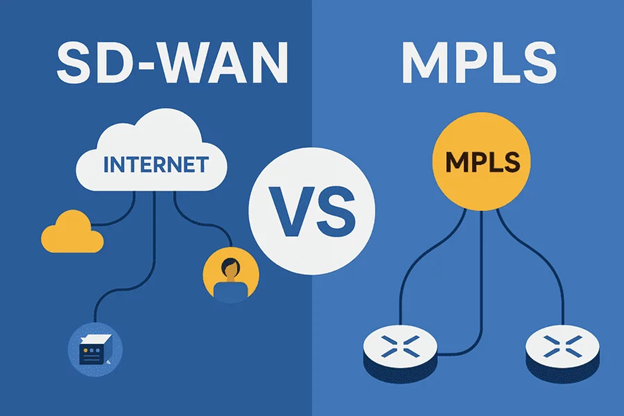
Is SD-WAN Cheaper Than MPLS?
In several multi-site manufacturing environments, WAN expenses can be lowered via SD-WAN, which employs broadband, LTE/5G and many other internet options along with or instead of dedicated MPLS connections over an MPLS-based architecture. Nevertheless, the realisation of these savings depends on a variety of factors such as bandwidth needs, locations used, security, licensing costs related to SD-WAN, equipment used, installation costs, etc.
TCO comparison is the right thing to do, and not mere monthly costs.
TL;DR
-
MPLS provides predictable, private WAN connectivity but can become expensive at scale.
-
SD-WAN creates a software-controlled WAN layer that can use multiple network connections.
-
SD-WAN can combine MPLS + broadband + LTE/5G instead of depending on a single circuit.
-
Manufacturers can potentially reduce connectivity costs while improving bandwidth flexibility.
-
SD-WAN can also centralise network management across geographically distributed plants.
-
Security must be designed carefully because internet-based connectivity introduces additional exposure.
-
A hybrid SD-WAN + MPLS model can be appropriate for plants with strict reliability or application requirements.
Why WAN Infrastructure Matters for Multi-Plant Manufacturers
A manufacturing-wide area network (WAN) links manufacturing facilities with corporate sites to the different applications and systems that they use on a day-by-day basis.
For example, a manufacturer with multiple plants may require connectivity to:
-
Manufacturing sites
-
Corporate headquarters
-
Regional sites
-
Warehouses
-
Distribution centres
-
Supplier location
-
Cloud computing facilities
-
Data storage sites
-
Remote engineering teams
These sites may use applications such as:
-
ERP systems
-
Manufacturing Execution Systems
-
Warehouse Management Systems
-
Enterprise Resource Planning systems
-
Industrial IoT platforms
-
Video surveillance systems
-
Voice and video communication systems
-
Cloud computing applications
-
CAD and engineering applications
It is important to highlight that equipment failure not only disrupts the email exchange process or office productivity.
It is also true that the ability to operate is a key factor for manufacturers because connectivity affects production visibility, stock management, plant monitoring, transportation issues, and communications.
What Is MPLS?
MPLS (Multiprotocol Label Switching) is a WAN technology that manages traffic over predetermined routes in a service provider's network.
MPLS has been frequently chosen by businesses due to its ability to provide reliable connectivity between locations. Cisco refers to MPLS as an age-old protocol for transporting packets through business networks.
Why manufacturers use MPLS
MPLS can be useful when a manufacturer requires:
-
Predictable network performance
-
Managed connectivity
-
Defined service-level agreements
-
Consistent latency
-
Private WAN connectivity
-
Connectivity for business-critical applications
However, MPLS generally requires dedicated circuits at the locations that need access to the MPLS network.
The scalability challenge
Imagine a manufacturer with 20 plants.
If every plant needs additional bandwidth, adding capacity through dedicated MPLS circuits can increase recurring connectivity expenditure.
The problem becomes more significant when:
-
Plants are geographically dispersed.
-
Cloud usage is increasing.
-
Video and IoT traffic are growing.
-
New facilities need to be connected quickly.
-
Multiple redundant links are required.
What Is SD-WAN?
SD-WAN, or Software-Defined Wide Area Network, is a software-controlled WAN architecture that can manage multiple underlying network connections from a central control layer.
Unlike an architecture dependent on one type of circuit, SD-WAN can work across different transports such as:
-
MPLS
-
Broadband
-
Dedicated internet
-
LTE
-
5G
IBM describes SD-WAN as a virtualised WAN architecture that centralises management and allows organisations to optimise connectivity across different network infrastructures.
How SD-WAN works
An SD-WAN platform evaluates network conditions and application requirements to determine how traffic should be handled.
For example:
Production-critical traffic → preferred high-quality link
ERP traffic → prioritised path
Video conferencing → dynamically optimised connection
General internet traffic → broadband connection
This application-aware approach is one of the reasons SD-WAN is increasingly considered for distributed enterprise networks.
SD-WAN vs MPLS Cost Comparison
The biggest difference is that MPLS is primarily a network transport technology, while SD-WAN is a software-defined networking layer that can manage multiple transports.
|
Factor |
MPLS |
SD-WAN |
|
Connectivity |
Primarily dedicated MPLS circuits |
Broadband, MPLS, LTE/5G and other transports |
|
Bandwidth cost |
Generally higher |
Can leverage lower-cost internet connectivity |
|
Traffic management |
More static |
Application-aware and policy-driven |
|
Centralised management |
Depends on architecture/provider |
Core capability |
|
Scalability |
Can require circuit provisioning |
New connectivity can often be added more flexibly |
|
Cloud access |
May require backhauling depending on design |
Designed to optimise diverse connectivity |
|
Redundancy |
Additional circuits may increase cost |
Can combine multiple links |
|
Hardware/software |
Network equipment and circuits |
SD-WAN appliances/software and subscriptions |
|
Security |
Requires separate security architecture |
Security may be integrated depending on solution |
|
Best fit |
Predictable private connectivity |
Distributed, hybrid and cloud-connected environments |
Important: SD-WAN is not automatically cheaper. Its TCO depends on licensing, hardware, connectivity, security, implementation and support.
What Makes MPLS Expensive for Manufacturers?
1. Dedicated bandwidth
MPLS bandwidth is typically provisioned through carrier circuits. As plants require more capacity, recurring connectivity costs can increase.
2. Multiple locations
A manufacturer with dozens of facilities may have dozens of WAN circuits to manage.
3. Redundancy requirements
If a plant requires two independent WAN connections, the business may need additional circuits and associated costs.
4. Cloud traffic
Modern manufacturing environments increasingly use cloud applications.
Traditional hub-and-spoke architectures can route traffic through central locations before reaching cloud services, potentially adding latency and consuming WAN capacity.
5. Expansion
Opening a new manufacturing facility can require connectivity planning, carrier availability checks, installation and configuration.
This can make WAN expansion slower and more expensive than using readily available internet services.
How SD-WAN Can Reduce Network Costs
SD-WAN can reduce WAN costs by allowing organisations to combine lower-cost connectivity options with intelligent traffic management instead of relying exclusively on expensive private circuits.
1. Use broadband alongside MPLS
A plant could use:
-
One MPLS connection
-
Two broadband connections
-
LTE/5G as additional backup
SD-WAN can manage these connections as part of a unified WAN strategy.
2. Increase bandwidth without relying entirely on MPLS
Instead of upgrading an MPLS circuit whenever bandwidth requirements increase, organisations can potentially add broadband capacity where application and security requirements allow it.
3. Reduce manual network management
Centralised SD-WAN management can simplify configuration and monitoring across distributed locations.
4. Improve link utilisation
SD-WAN can make use of multiple available connections instead of leaving backup bandwidth idle under normal circumstances.
5. Simplify new-site deployment
Some SD-WAN architectures support zero-touch provisioning, allowing network equipment at a new location to be configured centrally.
Manufacturing Use Cases
1. ERP and MES Connectivity
Manufacturing plants depend on ERP and MES platforms for production planning, inventory, orders and operational visibility.
SD-WAN can prioritise application traffic based on defined business policies.
2. Industrial IoT
Connected machines can generate large amounts of data.
SD-WAN can help organisations manage traffic across different connectivity paths while maintaining centralised visibility.
3. CCTV and Video
High-resolution video can consume significant bandwidth.
Instead of sending every type of traffic through an expensive private connection, traffic can be segmented and prioritised according to business requirements.
4. Cloud Manufacturing Applications
As manufacturers adopt SaaS and cloud infrastructure, direct and optimised access to cloud services becomes increasingly important.
SD-WAN is designed to operate across multiple connectivity types and can provide centralised traffic policies for cloud-bound applications.
5. Remote Plant Monitoring
Engineering and IT teams can monitor geographically distributed facilities through centralised network management and monitoring tools.
6. Hybrid SD-WAN + MPLS Architecture
For many manufacturers, the practical question is not “SD-WAN or MPLS?” but “Where should we use MPLS, and where can SD-WAN use alternative connectivity?”
A hybrid architecture might look like this:
Headquarters / Data Centre
|
SD-WAN Fabric
/ | \
MPLS Internet 5G
| | |
Plant A Plant B Plant C
A large plant with highly sensitive operational applications might retain MPLS.
A smaller warehouse may use dual broadband.
A temporary or remote facility could potentially use broadband plus 5G.
The SD-WAN layer provides centralised policy and traffic management across these different transports.
This approach can reduce dependence on a single connectivity type without forcing every site into the same network design.
Step-by-Step: How to Compare SD-WAN vs MPLS Cost
Step 1: List every location
Create a complete inventory of:
-
Plants
-
Offices
-
Warehouses
-
Distribution centres
-
Data centres
-
Remote facilities
Step 2: Document bandwidth requirements
Record current and expected bandwidth for every site.
Consider:
-
ERP
-
MES
-
IoT
-
CCTV
-
Voice
-
Video
-
Cloud applications
-
Backup traffic
Step 3: Calculate current MPLS TCO
Do not look only at monthly circuit charges.
Include:
-
MPLS circuits
-
Installation
-
Router costs
-
Maintenance
-
Managed services
-
Support
-
Redundant circuits
-
Security appliances
-
IT administration
Step 4: Build an SD-WAN TCO model
Include:
-
SD-WAN appliances
-
Software subscriptions
-
Broadband
-
Dedicated internet
-
LTE/5G
-
Security licences
-
Deployment
-
Monitoring
-
Support
-
Training
-
Migration
Step 5: Calculate downtime impact
Ask:
What does one hour of network downtime cost the plant?
Consider:
-
Production delays
-
Lost orders
-
Idle employees
-
Logistics disruption
-
IT recovery
-
Customer impact
Step 6: Compare three scenarios
Build separate models for:
-
MPLS-only
-
SD-WAN with internet
-
Hybrid SD-WAN + MPLS
This gives management a more realistic picture than comparing circuit prices alone.
Benefits of SD-WAN for Multi-Plant Manufacturers
Cost flexibility
Businesses can potentially reduce dependence on expensive private WAN circuits.
Better scalability
New plants and warehouses can be integrated using available connectivity options.
Centralised management
Network policies can be managed from a central platform.
Application awareness
Critical applications can receive specific traffic policies.
Connectivity redundancy
Multiple WAN links can provide additional resilience.
Cloud optimisation
SD-WAN can help organisations manage traffic between plants and cloud applications more efficiently.
Operational visibility
Centralised monitoring provides greater visibility into application and network performance.
Limitations and Risks
SD-WAN is not a magic replacement for every MPLS deployment.
1. Internet quality varies
Broadband performance can differ significantly by geography and provider.
2. Security needs careful design
Moving traffic onto internet-based connectivity introduces security considerations. Manufacturing environments also have operational technology (OT) and industrial control systems that require appropriate segmentation and protection.
3. Licensing costs
SD-WAN may involve recurring software and security subscriptions.
4. Migration complexity
Replacing an existing WAN across dozens of plants requires planning and testing.
5. Not every application should use the same path
Critical manufacturing workloads may have stricter requirements than ordinary internet traffic.
Common Mistakes
1. Choosing based only on monthly connectivity cost
2. The cheapest circuit is not necessarily the cheapest network.
3. Always calculate five-year or three-year TCO, depending on the organisation's planning horizon.
4. Removing MPLS everywhere
5. Some plants may still benefit from MPLS.
6. A hybrid model can be more appropriate than an immediate full replacement.
Ignoring security
SD-WAN does not automatically make an internet connection secure. Security capabilities depend on the selected architecture and platform.
Forgetting operational technology
Manufacturing networks include OT systems that may have different availability and security requirements from traditional IT applications.
Underestimating migration costs
Budget for:
-
Deployment
-
Testing
-
Training
-
Monitoring
-
Support
-
Temporary parallel operation
Best Practices for Multi-Plant SD-WAN Deployment
-
Segment IT and OT traffic.
-
Define application priorities before deployment.
-
Use redundant connectivity for critical facilities.
-
Measure latency, jitter, packet loss and availability.
-
Build security into the architecture.
-
Start with a pilot plant.
-
Maintain clear rollback procedures.
-
Standardise configurations where possible.
-
Monitor application performance continuously.
-
Review WAN costs regularly as bandwidth requirements change.
Expert Tips for Calculating SD-WAN ROI
The strongest SD-WAN business case combines direct savings and operational savings.
Direct savings
Calculate reductions in:
-
MPLS circuits
-
Bandwidth charges
-
Hardware
-
WAN maintenance
Indirect savings
Consider:
-
Reduced troubleshooting time
-
Faster site deployment
-
Improved visibility
-
Less manual configuration
-
Lower downtime exposure
-
Better utilisation of existing links
A manufacturer should therefore compare:
SD-WAN TCO = Connectivity + Hardware + Licences + Security + Support + Deployment + Operations
against:
MPLS TCO = Circuits + Hardware + Security + Support + Redundancy + Operations
Real-World Examples
The possible financial advantage is more than just a hypothesis.
Fortinet’s case analysis highlighted a situation in which HR Path was able to replace its MPLS setup with Secure SD-WAN, yielding a saving of at least US$13,000 annually for each location.
Another example can be drawn from Pacific National, which had its SD-Branch implemented at 86 different locations. The organisation has improved network functionality, availability and reliability while the CIO claims that network charges have been halved.
Manufacturing serves as a comparable example as well. A new Cisco case study about Nestlé provides detailed information regarding its international network, including about 1,700 locations, very costly MPLS connections, insufficient tools and performance difficulties.
These cases demonstrate the importance of making a proper evaluation of the SD-WAN system based on each individualorganisation’ss circumstances and needs.
Key Takeaways
SD-WAN vs MPLS cost should be evaluated using total cost of ownership rather than circuit price alone.
The key considerations are:
-
MPLS offers predictable managed connectivity.
-
SD-WAN can use multiple network transports.
-
SD-WAN can potentially reduce WAN connectivity costs.
-
Hybrid SD-WAN + MPLS can preserve private connectivity where it matters.
-
Broadband and 5G can provide additional bandwidth and redundancy.
-
Centralised management can reduce operational complexity.
-
Security and OT segmentation are essential for manufacturing.
-
The right architecture depends on application requirements, geography and business-criticality.
FAQs
1. Is SD-WAN cheaper than MPLS?
The cost savings of SD-WAN compared with MPLS come into play since SD-WAN can utilise less expensive technologies like broadband internet and cellular communication. The amount of savings will be contingent upon the design of the entire network and its total cost of ownership.
2. Can SD-WAN completely replace MPLS?
Yes, it can replace MPLS in certain cases, or it can run on it.
3. Why is MPLS expensive for manufacturing companies?
MPLS can entail high costs due to the necessity of circuit provisioning for every plant or branch, as well as extra bandwidth and backup links.
4. Does SD-WAN improve network performance?
SD-WAN can enhance application performance by actively managing the paths of traffic based on established policies and current network conditions.
5. Is SD-WAN secure?
The security of SD-WAN depends on the technology used and its implementation. Organisations must ensure that they correctly employ encryption, segmentation, firewalls, access control, and monitoring matching their IT and Operational Technology environments.
6. Can SD-WAN use MPLS and broadband together?
Yes. One of the major advantages of SD-WAN is its ability to operate across multiple transport types, including MPLS, broadband and cellular connectivity.
7. Is SD-WAN suitable for manufacturing plants?
SD-WAN can be suitable for manufacturers with geographically distributed plants because it supports centralised management, multiple connectivity options and application-aware traffic policies.
8. What costs should be included when comparing SD-WAN and MPLS?
Include connectivity, hardware, software licences, security, installation, support, monitoring, IT labour, redundancy and migration costs.
9. Should a manufacturer use SD-WAN at every plant?
Not necessarily. Site requirements differ. A large production plant may require different connectivity and redundancy from a small warehouse or sales office.
10. What is the biggest mistake when calculating SD-WAN ROI?
The biggest mistake is comparing only the monthly MPLS bill with the price of an internet connection. A proper analysis should include the complete TCO and operational impact.
Conclusion
For multi-plant manufacturers, the discussion around SD-WAN versus MPLS is ultimately about network architecture, not about connectivity prices. MPLS is able to provide reliable connectivity for applications and locations requiring that type of network service, but SD-WAN offers manufacturers the freedom to use MPLS together with broadband, internet and wireless data. This makes a hybrid SD-WAN architecture particularly valuable for organisations moving away from traditional WAN networks to cloud-based manufacturing processes. The best way to come to a decision is to model three cases: MPLS-only, SD-WAN, and hybrid SD-WAN + MPLS, based on real-life requirements from the locations, application traffic, carrier pricing, security needs and cost of maintenance.
We aim not just to replace MPLS but rather to create a WAN that will provide the desired quality, reliability, security, scalability, and cost of service for each manufacturing location. Planning a WAN upgrade across multiple manufacturing plants? Start with a detailed assessment of your current connectivity, bandwidth requirements, application traffic and network costs. A structured SD-WAN vs MPLS TCO assessment can help identify where MPLS should be retained, where broadband or cellular connectivity can be introduced, and where a hybrid architecture can improve network flexibility.
Contact Now:- B M Infotrade Pvt. Ltd.


Anshul Goyal
Group BDM at B M Infotrade | 11+ years Experience | Business Consultancy | Providing solutions in Cyber Security, Data Analytics, Cloud Computing, Digitization, Data and AI | IT Sales Leader