
Master Data Management Services: One Source of Truth for Faster Decisions
Master data management (MDM) services bring customer, product, vendor and employee data from every system into one accurate, governed record, a single source of truth. BM Infotrade helps Indian businesses remove duplicates, fix inconsistencies and share trusted data across ERP, CRM and analytics, so teams decide faster.
01
Oct
Master Data Management Services: One Source of Truth for Faster Decisions
Published 01 Oct 2026 Updated 01 Oct 2026 Written and reviewed by Anshul Goyal
The services provided under the master data management umbrella enable the creation of a comprehensive picture of customers, products, vendors, employees, places, and other essential entities. During this process, the records undergo integration and cleansing, and data is matched and governed so that conflicting records may be produced through the use of MDM tools, while providing high-quality data.
The term MDM, according to IBM, denotes the process of producing golden records from a wide range of information sources, and Microsoft declares integrated MDM and governance to be the keystones of accurate data.
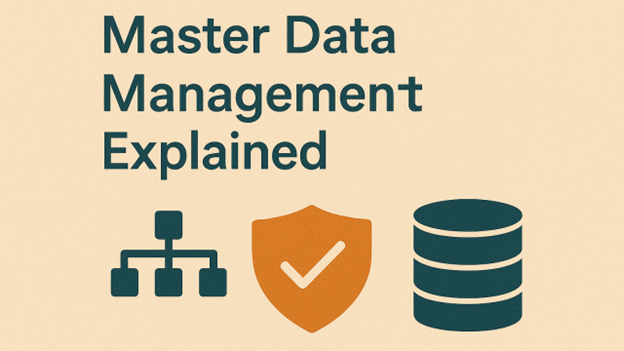
The function of master data management identifies mistakes and repetitions and updates them to bring them to uniformity. That is why this unified database minimises the reconciliation period and expedites decision-making concerning processes, finances, customers, supply chain, and compliance.
-
1. MDM creates trusted records across disconnected systems.
-
2. It combines technology, governance, workflows, quality controls, and ownership.
-
3. Common domains include customer, product, supplier, location, and employee data.
-
4. Successful programmes begin with one high-value use case.
-
5. MDM delivers value when trusted records reach operational and analytical systems.
What Do Master Data Management Services Include?
Master data management services include people, procedures, rules, and platforms required for maintaining accuracy and consistency of shared business data.
-
1. Planning: Business case, priorities, road map, and metrics.
-
2. Discovery: Source assessment, profiling, lineage and quality analysis.
-
3. Modelling: Definitions, attributes, hierarchies and relations.
-
4. Data quality: Validation, standardisation, enrichment and exceptions.
-
5. Entity resolution: De-duplication and record merging.
-
6. Governance: Ownership, policies, approvals, controls and audit.
-
7. Integration: ERP, CRM, e-commerce, data platform, and legacy systems.
-
8. Stewardship: Review of uncertain matches and policy exceptions.
-
9. Managed operations: Monitoring, tuning of rules, support, and improvements.
According to SAP, unified governance, standardisation, and managing the process of master data distribution are important. What makes the established source of truth important?
The established source of truth gives appropriate teams one proven understanding of customers, products, suppliers, and others.
Without MDM, the same customer can have several names, product categories can be confused, and different supplier methods can be used. Employees spend time matching the worksheets rather than working.
Good master data guarantees:
-
1. Consistency of KPIs and reports
-
2. Correct classification of customers
-
3. Proper warehouse management
-
4. Quick onboarding of suppliers
-
5. Better compliance reports
-
6. More effective data for AI and analytics
-
7. Fewer mistakes in invoicing and fulfilment
Key takeaway: A source of truth is useful only when governance keeps it current, and integrations deliver it where decisions happen.
How Does Master Data Management Work?
Master data management services convert fragmented records into governed, reusable data through a controlled lifecycle.
Step 1: Select the Domain
Start with a measurable problem that consists of duplicate customers, SKU inconsistencies, or suppliers with incomplete records.
Step 2: Discover the Sources
Identify the location of the data, its movements, and fields where certain values are missing or don’t match.
Step 3: Define the Common Model
Make sure that you agree with definitions, mandatory fields, validation, reference data, and hierarchy.
Step 4: Match and Merge Duplicate Records
By implementing exact matching techniques, fuzzy matching, and statistical methods, it is possible to discover duplicate records across different databases. With the help of such systems, duplicate records could be connected and merged into one entity.
Step 5: Create the Golden Record
The use of survivorship rules allows the user to determine the most valid attribute value. For instance, one may consider the billing system to be the most trustworthy source of tax information while CRM might remain the final authority on a customer's preferences regarding how to be contacted.
Step 7: Publish Trusted Data
The approved records are then sent to relevant systems and applications that will utilise them for their purposes.
Step 8: Monitor Results
All duplicates, completeness, accuracy of matching, time of onboarding, effort spent on reconciliation, and errors are monitored.
MDM Approaches Compared
The architecture depends on how much control the MDM layer needs.
|
Approach |
How It Works |
Best Suited For |
Trade-Off |
|
Registry |
Links records while sources retain ownership |
Rapid cross-system visibility |
Limited central control |
|
Consolidation |
Copies data to a central hub |
Reporting and analytics |
Updates may not flow back |
|
Coexistence |
Hub and sources share updates |
Phased adoption |
Integration complexity |
|
Centralised |
Hub creates and controls records |
Strong standardisation |
Greater process change |
|
Multi-domain |
Governs connected domains |
Enterprise transformation |
Broader scope |
MDM vs Related Data Capabilities
These capabilities work together but solve different problems.
|
Capability |
Main Purpose |
Core Question |
|
MDM |
Creates trusted core entities |
Which record is authoritative? |
|
Data governance |
Defines ownership and policy |
Who can change it, and how? |
|
Data integration |
Moves data between systems |
How does it travel? |
|
Data quality |
Tests and improves data |
Is it accurate and complete? |
|
Metadata management |
Explains meaning and lineage |
What does it mean and where is it from? |
Microsoft integrates MDM with governance as reliable records need both IT skills and business expertise.
-
1. Key advantage: Quicker decisions with reliable information.
-
2. Quick reporting: Less manual reconciliation.
-
3. Enhanced customer satisfaction: Unified view from sales, marketing, and support.
-
4. Effective operations: Less duplication of vendors, products, and accounts.
-
5. Robust analytics and AI: Same entities and connections.
-
6. Reduced risk: Changes carefully monitored, traceable, and verifiable.
-
7. Transformational approach: Better functioning of ERP, CRM, cloud, and data systems.
-
8. Greater collaboration: Common terms and definitions in business processes and IT.
Limitations and Challenges
MDM cannot resolve undefined ownership or ineffective processes on its own.
-
1. Disputes over definitions and source authorities
-
2. Poor quality source data and unrecorded legacy rules
-
3. Difficulties in matching from languages and channels
-
4. Overdoing manual process management
-
5. Lagging in integrating with old systems
-
6. Extension of the scope before gaining value
-
7. Objections to new processes
MDM is a process that never stops.
Common MDM Mistakes
Most MDM failures begin with governance or scope.
-
1. Buying a platform before defining the outcome
-
2. Attempting every domain at once
-
3. Treating IT as the only data owner
-
4. Auto-merging records without risk thresholds
-
5. Cleaning old data without preventing new errors
-
6. Creating golden records that systems do not consume
-
7. Measuring activity instead of business results
Best Practices and Expert Tips
Effective MDM connects each technical control to a business outcome.
-
1. Begin with one painful, valuable use case.
-
2. Assign a business owner and named data stewards.
-
3. Define good data with measurable rules.
-
4. Use risk-based match thresholds and preserve lineage.
-
5. Automate clear cases and route ambiguous cases for review.
-
6. Design integrations before mass cleansing.
-
7. Measure business KPIs alongside data-quality metrics.
-
8. Expand domain by domain after proving value.
Expert tip: Do not force one system to own every attribute. Attribute-level survivorship often creates a more accurate golden record.
Real-World Examples
1. Retail
A retailer merges product data across merchandising, ecommerce, warehouses, and suppliers. Consistent SKUs reduce listing errors and improve inventory visibility.
2. Banking
A bank links customer records across products, improving service, onboarding, risk analysis, and reporting.
3. Manufacturing
A manufacturer standardises material and supplier records across ERP systems, improving spend analysis and reducing duplicates.
4. Healthcare
A healthcare network has control of the information regarding patients, providers, and even locations. According to Informatica, healthcare MDM means that one can get an authoritative view of such entities. The study proves that supplier decision-making has become faster.
Due to multiple locations of the manufacturing company, there were several records of suppliers in both procurement and finance systems. There were different names, tax IDs, and bank details recorded in supplier data.
-
1. The source data was analysed, and all the fields were identified.
-
2. After that, duplicates were identified by tax IDs, addresses, banking information, and their similarities were evaluated.
-
3. The company made certain workflows for obtaining approvals for new suppliers and bank data changes.
The procurement, financial information, and analytical systems turned from relying on many suppliers into one logical record.
Lesson: Value came from combining rules, ownership, workflow, and integration not merely consolidating records.
Key Takeaways
-
1. MDM creates and maintains trusted business entities.
-
2. A golden record combines approved attributes from selected sources.
-
3. MDM, governance, integration, quality, and stewardship must work together.
-
4. Start with a measurable business problem, not a feature list.
-
5. Decision speed improves when mastered data enters daily workflows.
People Also Ask: FAQs
1. What are master data management services?
There are strategies, executions, administrations, quality checks, integration and communication and help services that are used to build trustworthy master records.
2. What is considered master data?
Typical areas of application are customers, products, vendors, workforce, place, goods, expenses and organisation.
3. What is a golden record?
It is the most accurate representation of one entity – it is done by record matching and obtaining trustworthy attribute values.
4. Is MDM the same as a data warehouse?
No, MDM is in charge of authoritative entities, and the data warehouse only stores integrated historical data that is used for analytical purposes.
5. Does MDM replace ERP or CRM?
Typically no, MDM gives constant records, but ERP and CRM systems work in a typical manner.
Conclusion
Master data management services provide companies with a reliable foundation for quick decision-making. MDM solves the problem of data duplication, the problem of definitions governance, and the problem of record ownership while creating golden records.
Great programs include quicker onboarding, clearer reports, fewer errors, and reliable analytics. The process should start with a single domain, the governance should be established, and the measure of results should be made in order to scale the process.
Do you wish to substitute contradictory data with reliable actionable data? Contact an MDM specialist today to evaluate priority areas, measure data quality risks, and create a step-by-step plan for developing an authoritative source of truth.





Anshul Goyal
Group BDM at B M Infotrade | 11+ years Experience | Business Consultancy | Providing solutions in Cyber Security, Data Analytics, Cloud Computing, Digitization, Data and AI | IT Sales Leader