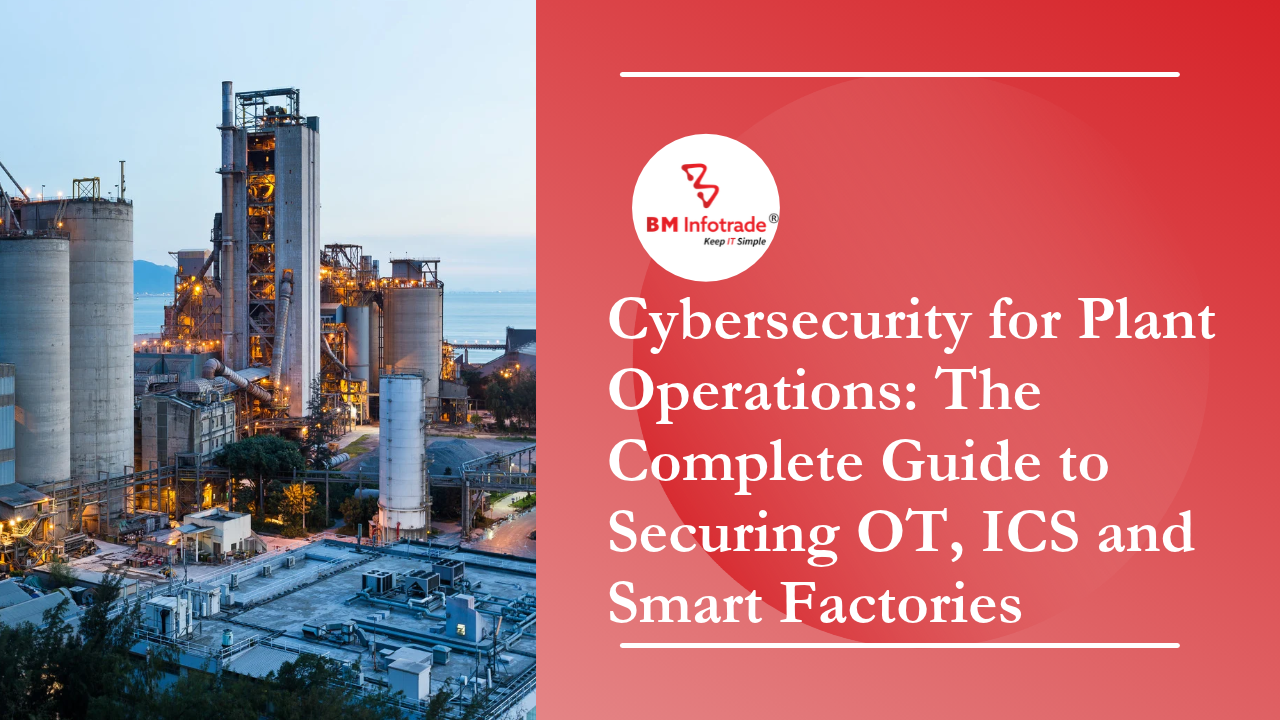
Cybersecurity for Plant Operations: The Complete Guide to Securing OT, ICS and Smart Factories
Explore how to secure plant operations with robust OT and ICS cybersecurity strategies. Learn about industrial threat protection, smart factory security, risk management, and best practices to safeguard critical infrastructure and ensure operational continuity.
24
Nov
Cybersecurity for Plant Operations: The Complete Guide to Securing OT, ICS and Smart Factories
Published 24 Nov 2026 Updated 24 Nov 2026 Written and reviewed by Anshul Goyal
Table of Contents
- Cybersecurity for plant operations: the quick answer
- What is cybersecurity for plant operations?
- Why plant operations are a target
- The most common attack paths into a plant
- Standards and frameworks for plant cybersecurity
- An 8-step framework for securing plant operations
- 90-day roadmap for plant cybersecurity
- How much does cybersecurity for plant operations cost?
- Build in-house or use a managed service?
- Plant cybersecurity checklist
- How to choose a plant cybersecurity partner
- How BM Infotrade helps secure plant operations
- Frequently asked questions
-
- 1. What is cybersecurity for plant operations?
- 2. What is the difference between IT security and OT security?
- 3. How much does OT security cost?
- 4. What is IEC 62443?
- 5. How do I secure legacy PLCs and HMIs that cannot be patched?
- 6. What is the first step in plant cybersecurity?
- 7. Is a firewall enough to protect a plant?
- 8. How long does a plant security assessment take?
- 9. Do small and mid-sized plants need OT security?
- 10. How does BM Infotrade help with plant cybersecurity?
-
- Get a plant cybersecurity assessment
- Sources
Cybersecurity for plant operations: the quick answer
Cybersecurity for plant operations is the practice of protecting the operational technology (OT) that runs a plant, including PLCs, SCADA, HMIs, sensors and the networks that connect them, from attacks that could stop production or endanger safety. It combines asset visibility, network segmentation, secure remote access, continuous monitoring and tested incident response, aligned to standards such as IEC 62443 and NIST SP 800-82.
Key takeaways
• Plant security is different from office IT security. Availability and safety come first, systems last 15 to 30 years, and patching is rarely simple.
• Start with what you cannot see. An accurate asset inventory and a segmented network remove most of the avoidable risk.
• Costs depend on assets, sites and coverage hours. Published prices are scarce, so this guide shows a sourced example and a cost-driver model you can use for budgeting.
• A 90-day roadmap can take a plant from unknown exposure to a monitored, segmented and recoverable environment.
What is cybersecurity for plant operations?
A modern plant runs on two connected worlds. Information technology (IT) covers email, ERP, laptops and cloud services. Operational technology (OT) covers the control systems that make and move product: programmable logic controllers (PLCs), distributed control systems (DCS), supervisory control and data acquisition (SCADA) software, human-machine interfaces (HMIs), industrial sensors and safety systems.
Cybersecurity for plant operations, also called OT security, industrial cybersecurity or ICS security, protects that second world. The goal is not only to protect data. It is to keep the process running safely, keep product quality predictable and recover fast when something goes wrong.
As plants connect to ERP, cloud analytics, remote vendors and AI tools, the boundary between IT and OT has blurred. That connectivity improves efficiency but gives attackers more paths into systems that were never designed to face the internet.
IT security vs. OT security: what changes on the plant floor
|
Factor |
Typical IT environment |
Plant OT environment |
|
Top priority |
Confidentiality of data |
Availability and safety of the process |
|
System lifespan |
3 to 5 years |
Often 15 to 30 years |
|
Patching |
Routine, automated, reboots acceptable |
Needs planned outage windows, vendor approval and testing; compensating controls often used |
|
Downtime tolerance |
Minutes to hours acceptable |
Near zero; downtime stops production |
|
Protocols |
Standard IT protocols |
Industrial protocols such as Modbus, DNP3, OPC and PROFINET |
|
Scanning and tools |
Active scanning is normal |
Passive monitoring preferred; active scans can disrupt fragile devices |
Why plant operations are a target
Industrial companies face real, measurable impact. In VDC Research data cited by Kaspersky (covering 2023 to 2024), industrial companies that neglected IT and OT protection averaged 3.8 incidents per year, about twice as many as better-protected competitors. Among companies with incidents that had measurable financial consequences, 25% reported damages above $5 million, and most incidents caused 4 to 12 hours or 12 to 24 hours of downtime.
Attackers go after plants for four reasons:
• Downtime creates leverage. A stopped line makes ransom demands more likely to be paid.
• Legacy systems. Unsupported operating systems and controllers with no built-in authentication are common.
• Flat networks. Once an attacker reaches the plant network, little stops movement between systems.
• Third-party access. Vendors, integrators and remote engineers often connect with broad privileges.
Real incidents show how IT problems become plant problems. In 2021, ransomware hit the IT systems of Colonial Pipeline, and the company shut down pipeline operations as a precaution. In 2019, a ransomware attack on Norsk Hydro pushed many of its plants to run in manual mode while systems were restored. In both cases, the business impact came from losing operational capability, not only from encrypted files.
The most common attack paths into a plant
1. IT-to-OT spread. Ransomware or malware enters through email or a compromised credential and moves toward the plant network.
2. Insecure remote access. Shared accounts, always-on vendor VPNs and exposed remote desktop services.
3. Unpatched legacy systems. Known vulnerabilities in HMIs, engineering workstations and older Windows hosts that cannot be updated easily.
4. Flat or poorly segmented networks. Office, plant and guest traffic sharing the same network.
5. Removable media and vendor laptops. USB drives and service laptops that bypass network defenses.
6. Supply-chain and software risk. Compromised updates, insecure third-party tools and weak integrator practices.
7. Weak monitoring. No visibility of OT traffic, so intrusions go unnoticed for weeks.
Standards and frameworks for plant cybersecurity
You do not have to invent a program from scratch. These frameworks give a proven structure, and many customers, insurers and regulators now expect alignment with at least one of them.
|
Framework |
What it covers |
Who it applies to |
|
IEC 62443 |
International series for securing industrial automation and control systems. Introduces zones and conduits, security levels and roles for asset owners, integrators and suppliers. |
Global; manufacturing and process industries |
|
NIST SP 800-82 |
US guidance for securing operational technology and industrial control systems. |
US-centric, widely used worldwide |
|
NIST CSF 2.0 |
Voluntary risk framework organized as Govern, Identify, Protect, Detect, Respond and Recover. |
Any organization |
|
NERC CIP |
Mandatory cybersecurity requirements for the North American bulk electric system. |
Power generation and transmission |
|
NIS2 |
EU directive raising cybersecurity obligations for essential and important entities, including parts of manufacturing. |
Organizations operating in the EU |
|
CMMC 2.0 |
US Department of Defense cybersecurity requirements for contractors. |
US defense supply chain |
|
ISO/IEC 27001 |
Information security management system standard; a strong governance base alongside OT-specific controls. See our ISO 27001 consulting services. |
Any organization |
Always confirm which requirements apply to you with your compliance team or regulator, because obligations differ by country, industry and contract.
An 8-step framework for securing plant operations
Step 1: Build an accurate asset inventory
You cannot protect what you cannot see. List every PLC, HMI, switch, historian, engineering workstation, sensor gateway and remote connection, with firmware versions, owners and network location. Passive discovery tools can map assets without disturbing the process. Expect the inventory to reveal devices nobody knew were connected.
Step 2: Run an OT risk assessment
Rank risks by operational impact, not only by technical severity. A good OT risk assessment covers governance and policy review, technical findings, a prioritized remediation roadmap and an executive summary. Pair it with controlled vulnerability assessment and penetration testing (VAPT) on the IT side and on the IT-to-OT boundary, so safety-critical devices are never tested carelessly.
Step 3: Segment the network
Separate corporate IT, the plant network and critical control zones using firewalls and a zones-and-conduits design (the Purdue model is a common reference). Only allow the specific traffic each zone needs. Industrial-grade firewalls and a well-planned network architecture limit how far an attacker can move and give you clear points to monitor.
Step 4: Secure remote access
Replace shared passwords and always-on vendor tunnels with named accounts, multi-factor authentication, session recording and time-limited access that you approve. Route all remote sessions through a controlled jump host instead of connecting directly into control networks.
Step 5: Monitor continuously
Deploy passive OT network monitoring and feed alerts into a security operations workflow. A 24x7 security operations center correlates plant, IT and endpoint signals, and extended detection and response (XDR) helps connect an email compromise to later activity near the plant. The aim is to detect unusual commands, new devices and lateral movement in minutes, not weeks.
Step 6: Manage vulnerabilities and patching realistically
Many OT devices cannot be patched on demand. Prioritize by exposure and exploitability, schedule patching with maintenance windows, and use compensating controls such as segmentation, virtual patching, application allow-listing and restricted access where patching is not possible. Keep endpoint protection on Windows hosts that support it, using vendor-approved configurations.
Step 7: Prepare to recover
Assume something will eventually fail. Keep offline, tested backups of PLC logic, HMI projects, configurations and historian data, and rehearse restoration. A tested backup and disaster recovery plan with backup and restore solutions often decides whether recovery takes hours or weeks. See how we helped one organization with ransomware prevention and data recovery.
Step 8: Train people and define governance
Assign clear ownership between IT, OT and plant management. Train operators and engineers on phishing, removable media and who to call during an incident. Run tabletop exercises that include plant managers, not only IT. Include physical security, such as CCTV and site network security, in the same program.
90-day roadmap for plant cybersecurity
|
Phase |
Focus |
Outcomes |
|
Days 1 to 30 |
Visibility and risk |
Asset inventory, network map, remote access review, risk assessment, quick wins such as removing exposed services and default passwords |
|
Days 31 to 60 |
Control and protection |
Segmentation design and first zones, multi-factor authentication for remote access, backup validation, incident response plan |
|
Days 61 to 90 |
Detection and readiness |
OT monitoring live, alerts connected to a SOC, tabletop exercise, 12-month improvement roadmap and budget |
Timelines vary with plant size, number of sites and maintenance windows. Treat this as a planning guide, not a promise.
How much does cybersecurity for plant operations cost?
There is no universal price list for plant cybersecurity. Cost depends on how many sites and assets you have, the age of your equipment, the coverage you need and whether you buy tools, services or both. Here is a practical way to estimate it.
What drives the price
|
Component |
How it is usually priced |
Main cost drivers |
|
OT risk assessment and asset discovery |
Fixed-fee project or per site |
Number of sites, number of assets, access constraints |
|
Network segmentation and industrial firewalls |
Hardware plus integration services |
Number of zones, redundancy needs, outage windows |
|
OT monitoring platform |
Annual subscription per asset, sensor or site |
Asset count; tiers can jump at thresholds |
|
Managed detection / 24x7 SOC |
Monthly or annual subscription |
Log sources, coverage hours, response scope |
|
Secure remote access |
Per user or per site subscription |
Number of vendors and remote users |
|
Incident response retainer |
Annual retainer |
Response time guarantees, included hours |
|
Training and tabletop exercises |
Per session or annual program |
Number of staff and sites |
This table describes how services are commonly structured. It is not a price quote.
A real example: 3-year cost model for one 50-device plant
Trout Software published a 3-year total cost of ownership model for a single manufacturing site with 50 OT devices, comparing a dedicated OT monitoring platform with firewalls against an integrated appliance. The figures below are from that model, so treat them as an example, not a quote.
|
Cost item |
Dedicated OT platform + firewalls |
Integrated appliance |
|
Year 1 hardware |
$42,000 |
$15,000 |
|
Year 1 software and licensing |
$54,000 |
$12,000 |
|
Year 1 services (integration and training) |
$25,000 |
$7,000 |
|
Year 1 total |
$121,000 |
$34,000 |
|
Years 2 and 3 (each, recurring) |
$94,000 |
$37,000 |
|
3-year total |
$309,000 |
$108,000 |
Important caveats: the source is a vendor that promotes its own product; renewals are held flat; monitoring and enforcement are both included; and the gap narrows if you already own compatible firewalls. The model also notes that a 50-device network can reach 80 to 120 billable assets once PLCs, HMIs, switches, historians and engineering workstations are all counted, and that integration typically takes 40 to 120 hours of engineering time.
What does an incident cost compared with prevention?
• Downtime and damage: per the VDC Research data cited above, 25% of industrial companies with measurable financial impact reported losses above $5 million.
• Fewer incidents with monitoring: companies using network and device monitoring saw average incidents fall from 2.7 to 2.2 per year.
• Modeled return: an Omdia analysis published by Palo Alto Networks modeled a midsize manufacturer (8 locations, about 4,000 OT and IoT assets) and estimated more than $2 million in avoided risk and a 384% five-year return. This is a vendor-published model, not a measured result.
Calculate your own downtime cost
Cost per hour of downtime = lost production value + idle labor + scrap and restart costs + contractual penalties + recovery costs. Multiply by the 4 to 24 hours typical of an incident, then compare the result with your annual security budget. Most plants find that a few hours of stoppage costs more than a year of baseline monitoring.
BM Infotrade engagement options
We scope every plant individually because assets, uptime constraints and regulations differ. These are our typical engagement models:
|
Package |
What is included |
Starting price (USD) |
|
OT security assessment |
Asset discovery, risk assessment, prioritized roadmap, executive report |
[Add your starting price] |
|
Segmentation and protection |
Zones-and-conduits design, firewall deployment, secure remote access |
[Add your starting price] |
|
Monitoring and managed SOC |
OT and IT monitoring, 24x7 alert triage, incident response support |
[Add monthly price per site] |
|
Full plant security program |
Assessment, protection, monitoring, backup and recovery, training |
[Request a custom quote] |
[Replace the bracketed prices with your real figures before publishing. Published, transparent starting prices improve trust and usually improve conversion.]
Request a scoped estimate: contact BM Infotrade or use our enquiry form.
Build in-house or use a managed service?
• In-house gives full control and deep plant knowledge, but needs scarce OT security skills, 24x7 coverage and ongoing tool tuning.
• Managed service gives round-the-clock coverage and faster setup, with predictable subscription costs, but you must define clear response roles and data-sharing rules.
• Hybrid is common: your team handles plant-specific decisions, while a partner provides 24x7 monitoring, threat detection and incident response. Our next-generation SOC works this way.
Plant cybersecurity checklist
Use this as a quick self-assessment. Every "no" is a priority item.
• We have a current inventory of every OT asset, with firmware versions.
• Corporate IT and the plant network are separated by a firewall.
• Critical control systems sit in their own zone.
• Remote access uses multi-factor authentication and named accounts.
• Vendor access is time-limited and approved each time.
• Default and shared passwords have been removed.
• We monitor OT network traffic for unusual activity.
• Security alerts are reviewed 24x7, not only in business hours.
• We know which devices cannot be patched and have compensating controls.
• PLC programs, HMI projects and configurations are backed up offline.
• We have tested restoring those backups.
• We have an OT-specific incident response plan with plant managers named.
• Removable media and service laptops are controlled and scanned.
• Operators and engineers receive security training at least yearly.
• We have run a tabletop exercise in the past 12 months.
How to choose a plant cybersecurity partner
1. OT and IT experience. Ask for examples in manufacturing or industrial settings, and speak to a reference.
2. Safety-first methods. They should use passive discovery and coordinate every change with plant operations.
3. Standards alignment. They should map their work to IEC 62443, NIST and your contractual requirements.
4. 24x7 detection and response. Ask about response times and who acts at night.
5. Clear scope and pricing. You should receive an itemized estimate covering assessment, tools, services and support.
6. Recovery capability. Backup, disaster recovery and incident response should be part of the plan.
7. Global delivery. If you run plants in several countries, confirm support coverage and time zones.
How BM Infotrade helps secure plant operations
BM Infotrade is a technology company with more than two decades of experience across IT infrastructure, cyber security, data and AI, and digitization. For plant operations we combine security, infrastructure and recovery in one program:
• Detection and response: 24x7 next-generation SOC and XDR services
• Testing and assurance: VAPT and ISO 27001 consulting
• Protection: next-gen security solutions, firewalls and networking
• Recovery: backup and disaster recovery
• Physical security: CCTV network solutions
We deliver services across multiple regions, including the United States, the UAE and Australia. Learn more about our full cyber security practice or browse our case studies, including manufacturing cloud transformation.
[Add 1 to 2 verified plant or manufacturing client results here: industry, challenge, outcome. Also add any OT-specific certifications or partner credentials you hold.]
Frequently asked questions
1. What is cybersecurity for plant operations?
It is the protection of the operational technology that runs a plant, including PLCs, SCADA systems, HMIs and industrial networks, from cyberattacks. It focuses on keeping production safe and available, and combines asset visibility, segmentation, secure remote access, monitoring and tested recovery.
2. What is the difference between IT security and OT security?
IT security protects data and business systems, with confidentiality first. OT security protects physical processes, with safety and availability first. OT systems last decades, cannot always be patched or scanned actively, and use industrial protocols, so tools and methods must be adapted.
3. How much does OT security cost?
Cost depends on sites, asset count, equipment age and coverage. One published model for a single 50-device plant estimated about $34,000 in year one for an integrated appliance and $121,000 for a dedicated platform with firewalls. Request a scoped quote for your plant.
4. What is IEC 62443?
IEC 62443 is an international series of standards for securing industrial automation and control systems. It defines zones and conduits, security levels and responsibilities for asset owners, integrators and suppliers, and is widely used as the benchmark for plant cybersecurity programs.
5. How do I secure legacy PLCs and HMIs that cannot be patched?
Isolate them in a protected network zone, restrict who and what can connect, monitor their traffic passively, remove direct internet access, control removable media and keep offline backups. These compensating controls reduce risk when patching is not possible.
6. What is the first step in plant cybersecurity?
Build an accurate asset inventory and network map. Visibility shows what is connected, what is exposed and where to segment. Most plants discover unknown devices and risky connections in this step, which makes it the best starting point.
7. Is a firewall enough to protect a plant?
No. A firewall is essential for segmentation, but it does not detect threats already inside, secure remote vendors, or help you recover. Plants need layered defenses: segmentation, access control, monitoring, vulnerability management and tested backups.
8. How long does a plant security assessment take?
It depends on plant size and access, but a focused assessment of one site often takes several weeks, including discovery, interviews, analysis and reporting. Passive methods are used so production is not disrupted. Your partner should give a written timeline.
9. Do small and mid-sized plants need OT security?
Yes. Attackers target availability, and smaller plants often have less monitoring and weaker segmentation. A phased program, starting with inventory, segmentation, remote-access control and backups, gives strong protection at a manageable cost.
10. How does BM Infotrade help with plant cybersecurity?
BM Infotrade provides 24x7 SOC monitoring, XDR, VAPT, ISO 27001 consulting, network and firewall solutions, and backup and disaster recovery. We combine them into a phased program that fits your plant's uptime needs and budget.
Get a plant cybersecurity assessment
Want to know where your plant stands? Talk to our security team for a scoped assessment and a clear, itemized estimate. Contact BM Infotrade or send an enquiry. Explore more guides on our blog.
Sources
• Kaspersky, citing VDC Research (2023 to 2024 data), OT cybersecurity costs and savings: https://www.kaspersky.com/blog/ot-cybersecurity-costs-and-savings/53733/
• Trout Software, TCO comparison for a 50-device manufacturing site (updated September 2026): https://www.trout.software/blog/the-true-cost-of-ot-security-tco-comparison-of-appliance-vs-cloud-solutions
• Palo Alto Networks, Omdia analysis of OT device security risk reduction: https://www.paloaltonetworks.com/blog/network-security/omdia-analysis-estimates-2m-risk-reduction-with-ot-device-security/
• Rockwell Automation, OT cybersecurity risk assessment components: https://www.rockwellautomation.com/en-id/capabilities/industrial-cybersecurity/products-services/risk-assessment.html
• Standards: IEC 62443, NIST SP 800-82, NIST CSF 2.0, NERC CIP, NIS2, CMMC 2.0 and ISO/IEC 27001 (refer to the official publishers for current requirements)

Anshul Goyal
Group BDM at B M Infotrade | 11+ years Experience | Business Consultancy | Providing solutions in Cyber Security, Data Analytics, Cloud Computing, Digitization, Data and AI | IT Sales Leader