
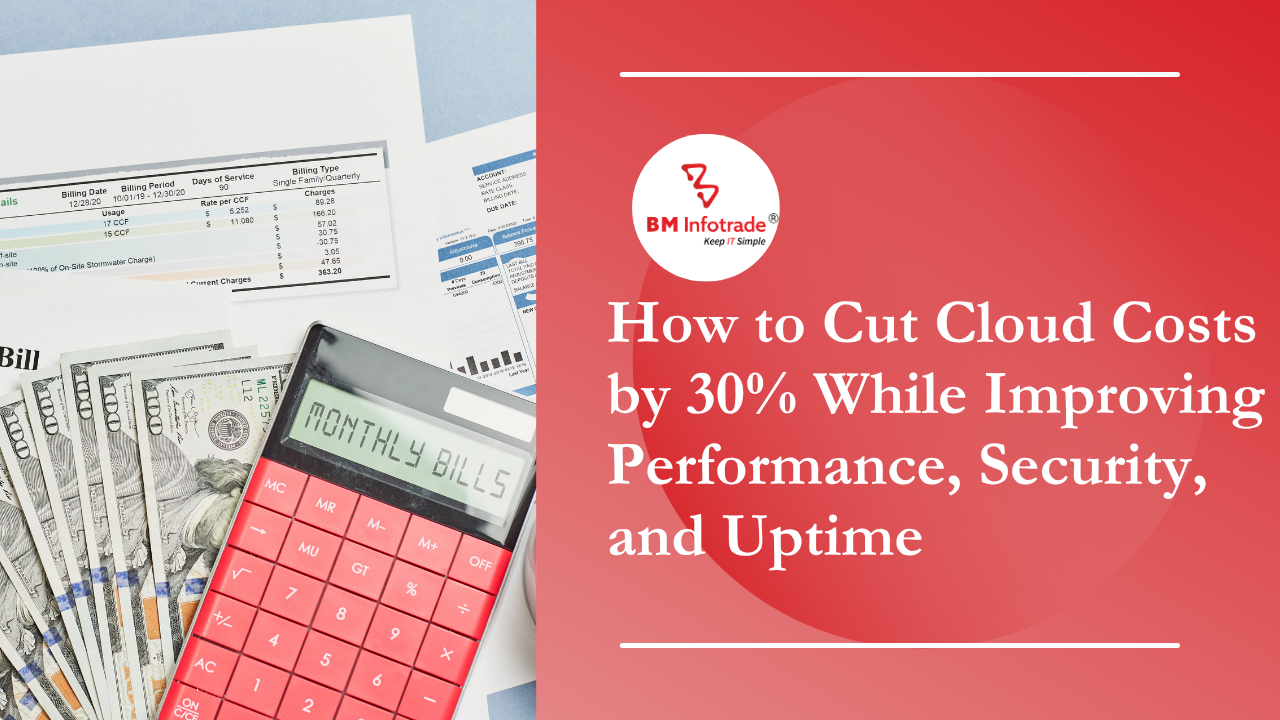
How to Cut Cloud Costs by 30% While Improving Performance, Security, and Uptime
Learn how to reduce cloud costs by up to 30% without compromising performance, security, or uptime. Discover practical strategies for cloud optimization, resource management, FinOps, and workload efficiency.
17
Aug
How to Cut Cloud Costs by 30% While Improving Performance, Security, and Uptime
Published 17 Aug 2026 Updated 17 Aug 2026 Written and reviewed by Anshul Goyal
Table of Contents
Cutting cloud costs by 30% is not about reducing resources blindly. It is about removing waste, improving architecture, automating governance, strengthening security, and making every cloud resource deliver measurable business value without compromising performance, compliance, or uptime.
Many organisations' CTOs or IT managers have prioritised lowering their cloud costs. But while many companies chose to move to the cloud because they appreciate its agility, their monthly expenses have jumped beyond any benefit received from being in the cloud.
There are several reasons why businesses are incurring higher costs with cloud services. Idle servers or unused resources, over-provisioned infrastructure (especially server resources), underutilised storage (not taking advantage of the features that a cloud service provides), poor tagging of resources (no classification for reporting), insufficient resource monitoring and usage reporting, unnecessary backups, and unplanned data transfer charges are all very common. The root cause of these cost escalations arises not from the cloud itself, but rather because of the low amount of effective governance of the cloud environment.
Through our technical assessments, we have concluded that most companies do not need to decrease their cloud footprint. However, they need to be much more strategic in their management of the cloud. Companies can save between 10% and 30% from the cloud by implementing a cloud management strategy. Additionally, they can improve speed, security, uptime and reliability by doing so.

Current Industry Challenges
Businesses utilize AWS & Microsoft Azure, Google Cloud, Kubernetes, Databases, SaaS tools, and security platforms in conjunction with each other, however, if they are unable to define who owns what or have visibility over their cloud spending, they will also struggle to control it (cloud spending).
Finance departments see bills, but Engineering departments run workloads, and Security departments only see risk. Therefore, without a unified governance structure in place, all teams will be reactive when it comes to optimisation.
Another area that presents challenges is over-provisioning. Teams often provision "large" servers, database instances, and storage volumes simply for the peace of mind of having the capacity available because they are worried about running out and/or having applications fail due to not having enough capacity available. This leads to additional costs without necessarily improving performance for users.
Security must also be taken into account when looking to lower costs; reducing backups, monitoring, encryption, identity and access management, and compliance will all seriously undermine any potential cost savings. A lower-cost solution in the cloud can be worthless if it causes you to have an outage or experience risk.
Technical Entities That Build Cloud Authority
A good cloud optimisation strategy should align with established industry standards and platforms. These entities are a way to create trust in technology and digitally.
The AWS Well-Architected Framework allows an organisation to evaluate whether the cost, performance, reliability, security, and operational excellence of their cloud environment meet current best practices.
The FinOps Framework bridges Engineering, Finance, and Leadership to drive accountability and cultural change for cloud spending through collaboration.
ISO/IEC 27001 provides secure management of information and establishes compliance readiness for the organisation's use of the cloud.
The NIST Cybersecurity Framework is a method for managing risk to an organisation's cloud environment through the use of common controls.
While Kubernetes is a platform to manage scalable containerised workloads, it must be governed correctly in order to avoid unnecessary costs and complications.
Architecture Table: Traditional Method vs Our IT Solution
|
Area |
Traditional Method |
Our IT Solution |
|
Cost Visibility |
Monthly bill review after cost increases |
Real-time dashboards, tagging, alerts, and ownership |
|
Compute |
Fixed servers running continuously |
Rightsizing, autoscaling, reserved capacity, and scheduling |
|
Storage |
All data is stored in active expensive tiers |
Lifecycle policies, archive tiers, and backup optimisation |
|
Security |
Separate cost and security reviews |
Integrated IAM, encryption, monitoring, and compliance |
|
Performance |
Add more resources when systems slow down |
Caching, database tuning, CDN, and workload optimisation |
|
Uptime |
Manual recovery after failure |
High availability, failover, observability, and DR planning |
Step-by-Step Roadmap to Cut Cloud Costs by 30%
Step 1: Build Complete Cloud Visibility
The first step to figuring out how to budget properly is understanding where your money is spent. Each cloud resource should have practical tags applied for tracking at least Department, Application, Owner, Environment and Cost Centre.
These tags assist all levels of management to find excess virtual machines, unutilized storage, too many oversized databases, duplicate backups and excess public IP addresses that a business does not use.
Step 2: Rightsize Compute and Databases
One of the largest areas of expense in the cloud tends to be compute resources. Servers are typically configured and migrated, and then aren’t observed until hard cash is spent on them.
From an implementation perspective, rightsizing is achieved by reviewing actual CPU, Memory, Disk and Network usage against the capacity provisioned. At that point, your company can move workloads to what best fits the instance, thus reducing waste.
Database optimisation is equally necessary to reduce costs and latency. Poor indexing, too many IOPS, oversized databases and inefficiently coded queries can add both cost and latency to all of a company’s cloud resources.
Step 3: Automate Scaling and Scheduling
There is no disadvantage to scheduling workloads based on business hours if workloads do not need to be operational 24/7. Workloads usually can be scheduled between business hours.
Production workloads will benefit from autoscale in order to automatically generate additional capacity during peak demand and to return to a less costly capacity during lower demand periods; therefore, this will help with both financial control and system availability.
Step 4: Optimise Storage and Backups
There are several costs associated with traditional storage expansions as a result of obsolete logs, backups, media files, etc.
In order to keep the cost of storage down, you should have a storage plan in place that includes a way to eliminate obsolete data, move dormant files to a lower-cost tier of storage, develop lifecycle policies for inactive file retention, regularly review retention policies, and compress duplicated files.
Increasing the number of backups is not the goal of a smart retention strategy. The goal is equalisation.
Step 5: Strengthen Security and Digital Identity
Having an identity and security audit as part of the cloud cost optimisation process will assist in increasing your financial performance and mitigating security exposures due to over-permissioned users, unused access keys, mismanaged storage access, and unreviewed or unmanaged admin roles.
A safe identity and security management model contains MFAs (multi-factor authentication) for users, uses least privilege access to secure storage, implements encryption for data at rest and in transit, implements centralised identity and security management, provides centralised security logging for data and security management systems, and regularly audits user access.
Why Choose Our IT Solution
An IT Solutions Company has an overall integrated architectural design style that combines cloud engineering, cybersecurity, compliance, performance optimisation, and managed services together into one comprehensive IT Solution.
Our Technical Team will work with clients to identify ways to reduce unnecessary cloud expenses, increase performance of their workloads, enhance the security posture of their applications, improve uptime for production-use applications, and move organisations to long-term Financial Operations maturity.
The result of all these efforts will not only be a more affordable cloud solution, but also a vastly more secure, reliable, scalable, and business-ready cloud computing environment.
Conclusion
With proper cloud cost optimisation identified through engineering, governance, automation, and security, we can reduce your cloud costs by up to 30%. By formulating the correct strategy for optimising the cloud, we are able to eliminate waste, provide better performance, create stronger identity access controls, and maximise uptime.
Cost optimisation in the cloud should not be an arbitrary method of reducing your costs but rather an intelligent operation model in which every resource is used for a specific purpose, every cost has an assigned owner, and the entire system is designed for resiliency.
Would you like to learn more about how you can reduce your cloud costs while maintaining performance, security and uptime?
Contact one of our Cloud Solution Architects today to schedule a Cloud Cost Optimisation Assessment, or download our Cloud Optimisation Whitepaper, which explains how you can use finance and operations (FinOps) practices led by engineering to improve your cloud governance and the reliability of your business.
FAQs
1. What is cloud cost optimisation?
The process of cloud cost optimisation is the act of cutting down on unnecessary cloud spending without hindering performance, addressing security concerns, or decreasing the uptime of systems.
2. Can cloud costs be reduced by 30%?
Correctly implementing a combination of rightsizing, autoscaling, storage optimisation, and FinOps will allow most organisations to achieve up to 30% reduction in their cloud costs.
3. Will cost reduction affect performance?
No, not if done accurately. Effective optimisation will remove waste from resource allocation and provide an enhancement to performance, ensuring customers receive only what they need based on the actual workload they have.
4. Why do cloud bills increase?
Many organisations see their monthly cloud bill increase because they are using oversized servers and have idle or unused resources and/or storage, as well as having poor monitoring and no one taking responsibility for usage and cost.
5. How does autoscaling help?
By utilising autoscaling, organisations can automatically scale their resource usage up and down depending on the amount of load (demand) currently placed on them, thus preventing organisations from having to pay for resources that are not being utilised.
Anshul Goyal
Group BDM at B M Infotrade | 11+ years Experience | Business Consultancy | Providing solutions in Cyber Security, Data Analytics, Cloud Computing, Digitization, Data and AI | IT Sales Leader