
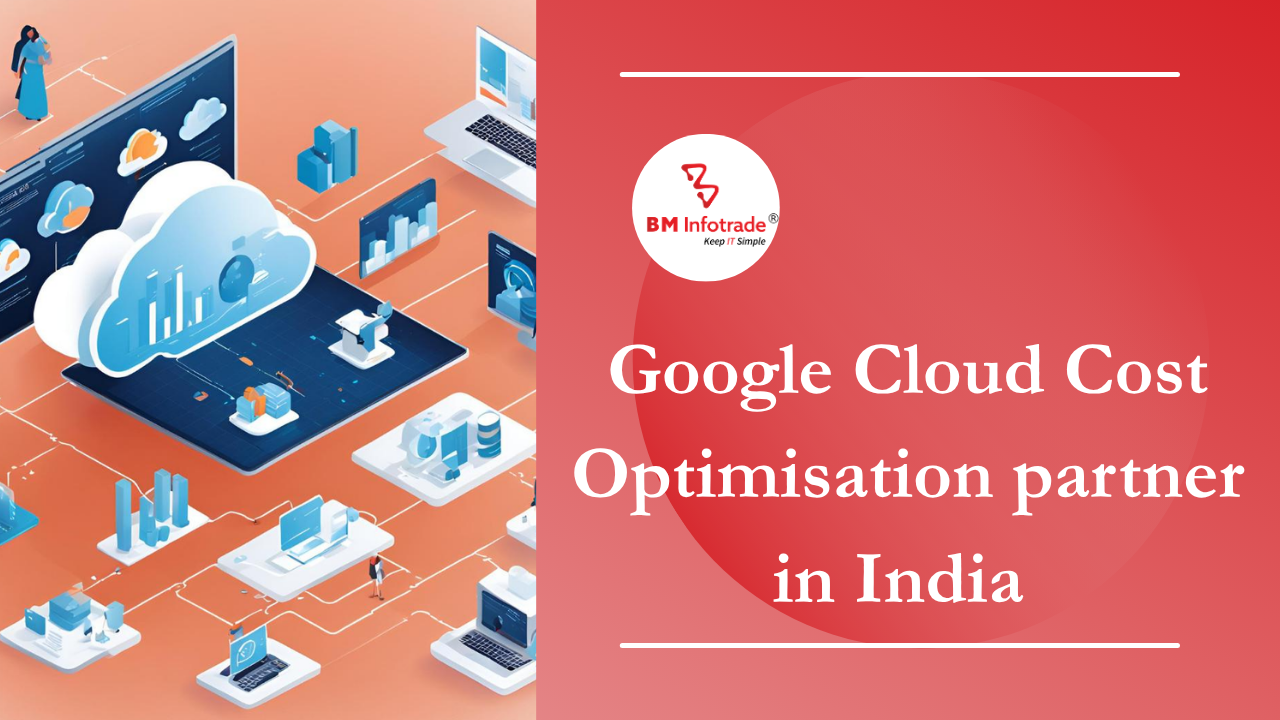
Google Cloud Cost Optimisation partner in India
BM Infotrade helps businesses optimise Google Cloud costs through continuous monitoring, rightsizing, resource optimisation, and FinOps best practices. Our certified cloud experts identify unnecessary spending, improve resource utilisation, and ensure your Google Cloud environment remains secure, scalable, and cost-efficient.
25
Jul
Google Cloud Cost Optimisation partner in India
Published 25 Jul 2026 Updated 25 Jul 2026 Written and reviewed by Anshul Goyal
Table of Contents
- What Is Google Cloud Cost Optimisation?
- Why Indian Businesses Need a Google Cloud Cost Optimisation Partner
- Current Industry Challenges
- Our Technical Solution Architecture
- Five Technical Entities That Build Digital Identity
- Implementation Roadmap
- Future-Proofing the Business
- Why Choose a Google Cloud Cost Optimisation Partner in India?
- Conclusion
- FAQs
India's businesses are leveraging Google Cloud Cost Optimisation to cut down on excess cloud costs by streamlining workloads and increasing returns on investment without sacrificing performance, uptime or security. A trustworthy provider of Google Cloud Cost Optimisation solutions for Indian businesses will assess their clients' billing practices and architecture; evaluate usage patterns and automation trends; and ensure adequate governance to allow businesses to convert their cloud costs into business value that can be assessed quantitatively.
What Is Google Cloud Cost Optimisation?
Google Cloud Cost Optimisation focuses on critical and continuous examination, control and improvement of each organisation's expenses related to Google Cloud cloud services. It is about not just reducing Google Cloud bills. Rather, it is about ensuring your Google Cloud usage is consistent with your company objectives, that your applications are delivering optimal performance, that you have appropriate levels of security, and that your cloud system can scale in the long term.
For CTOs, IT Managers, Finance Executives and Directors of Infrastructure, the current problem facing them is not that they have adopted Google Cloud, but rather that they don't have efficient use of Google Cloud. Many organisations are migrating to Google Cloud because of its scalability, speed and reliability. However, absent proper governance over those cloud expenses, companies can expect their cloud bills to be erratic and unpredictable.
Google Cloud offers a number of tools to assist organizations to manage and optimising their cloud expenses, such as Cloud Billing, the ability to set budgets and alerts, the FinOps Hub (a community and support network), the Recommender, and the ability to get recommendations on utilising committed use discounts.
Why Indian Businesses Need a Google Cloud Cost Optimisation Partner
In India, cloud usage is rapidly increasing across all industries, including fintech, healthcare, manufacturing, SaaS, retail, education, and digital-first start-ups. Now, businesses are leveraging cloud infrastructure at greater rates than ever before to support their applications, Analytics, AI, Automation, storage, security and overall customer experience.
The very nature of cloud technology is focused on optimizing performance while providing a cost efficient solution; however, when companies do not take the proper steps to ensure optimization, they can experience what is known as silent leakage through their operations because of the potential for large numbers of unused Virtual Machines, overextended Databases, idle Disks, poor Storage Lifecycle Management, weak Tagging, Uncontrolled Development Environments, and missing Budget Alerts.
The reality is that, according to our technical team, the vast majority of Cloud Cost Issues arise from a combination of many small operational gaps in multiple locations, instead of from one major error that may have occurred months or even years ago.
Current Industry Challenges
1. Unpredictable Monthly Cloud Bills
Most companies begin by configuring Google Cloud simply, but as their projects, teams, and workloads expand, billing becomes complicated to follow. When companies do not have a method to see costs per project level, finance departments have trouble determining which department, application, or environment caused that cost.
2. Over-Provisioned Infrastructure
When engineers build systems, they typically choose larger sizes of Compute Engine machines, database instances, or Kubernetes resources than necessary to eliminate performance problems. They may run fine short-term on these larger systems, but they could create longer-term waste.
3. Lack of FinOps Governance
Cloud cost optimisation is not just an engineering task; organisational IT, finance, security, and business collaboration are required for it to happen. In the absence of FinOps best practices, cloud spend will continue to be reactive vs strategic.
4. Poor Discount Planning
To provide predictable costs for workloads, Google Cloud offers customers support through commitment-based pricing options. However, correct project planning is vital during the commitment process since inappropriate commitment decisions can lead to future financial constraints.
5. Limited Visibility Across Projects
Large companies typically operate more than one Google Cloud project for purposes such as production use, test and staging purposes, analytical purposes, backup and development. Without implementing labels, utilising billing export capabilities, creating dashboards, and establishing access controls, project cost ownership can become ambiguous.
Our Technical Solution Architecture
In terms of implementation, optimising costs within Google Cloud involves creating a structured architecture that shares intelligence related to billing, appropriately sizes infrastructure, provides governance rules, uses automated processes, and includes ongoing monitoring.
|
Area |
Traditional Method |
Our IT Solution |
|
Billing Visibility |
Monthly invoice review after cost increase |
Real-time Cloud Billing dashboards, budgets, alerts, and project-level cost tracking |
|
Compute Usage |
Oversized VMs and always-on instances |
Right-sizing, autoscaling, scheduling, and committed use discount planning |
|
Kubernetes Cost |
Shared GKE clusters with unclear resource usage |
Namespace-level visibility, workload requests/limits, autoscaling, and cluster optimisation |
|
Storage Cost |
Data stored without lifecycle planning |
Storage class review, lifecycle rules, backup cleanup, and archival strategy |
|
Governance |
Manual approval and weak ownership |
IAM-based control, tagging policy, budget thresholds, and automated alerts |
|
Reporting |
Finance and IT work separately |
FinOps dashboard with cost centre, department, application, and environment mapping |
Five Technical Entities That Build Digital Identity
Building a strong entity-centric digital identity requires cohesive relationships between cloud entity-based services from Google Cloud, as well as with technical entities and the world’s cloud protocol of standards.
1. Google Cloud Billing
Cost Visibility begins with Google Cloud Billing – it provides organisations with the ability to establish budget configuration, set alerts when charges are incurred and understand how costs can vary across services and projects.
2. FinOps Hub
The www.FinOpsHub.com Web App allows teams to view their existing savings, gain insight into recommended ways to optimise their spending, and enable teams to set future savings targets based on previous usage patterns, as well as Google Cloud’s recommended strategies.
3. Google Cloud Recommender
The Google Cloud Recommender provides businesses with a platform from which to evaluate various cost-optimising opportunities associated with their resources, usage patterns, and anticipated resource commitments.
4. IAM and Cloud Governance
Identity Access Management can control who has permission to create, modify or delete the organisation's cloud-based resources; this is critical because without strict access discipline, you will never be able to optimise your cloud-hosted costs.
5. ISO 27001 and Security Compliance
Cloud cost optimisation should never compromise security; therefore, an accomplished partner will align their efforts for reducing their customers’ cloud costs as well as implementing security controls, preparing for audit, aligning with access governance, and building their business in accordance with established compliance frameworks, including but not limited to ISO 27001.
Implementation Roadmap
Phase 1: Cloud Cost Assessment
First off, we need an in-depth review of cloud billing & infrastructure. The technical team assesses how you are using Google Cloud at present; this includes reviewing your billing accounts, projects, services, the location of service usage (region), machine types, the size of storage being used, cost associated with networking, and data backup policy settings.
The aim of this process is to understand where the funds are currently spent, why they are being spent in that manner, and if those funds are aligned to provide business value.
Phase 2: Cost Visibility and Tagging
Next we’ve implemented a proper tagging and labelling strategy across all of your projects, departments, environments, and applications sites. This helps CTOs and the finance organisation understand who holds ownership to each tagged resource.
For example, your production, staging, development, analytics, and disaster recovery environments should be clearly defined and separated from one another. This will provide better cost reporting clarity and reduce confusion during the audit.
Phase 3: Resource Right-Sizing
After cloud infrastructure resource tagging & labelling has been performed, we will move on to a right-sizing review. This includes reviewing Compute Engine instances, Cloud SQL databases, and workloads across GKE, storage buckets and your network utilization by actual resource consumption.
Therefore, as an example, excessive provisioning of resources will be down-sized/adjusted; unused or unutilized resources will be removed completely; and if the workload can be scheduled to run based on normal business hours only, then that is what we will do. Autoscaling will be configured wherever applicable.
Phase 4: Budget Alerts and Automation
With Google Cloud budgets, organizations can monitor what they're actually spending compared to what they had planned to spend. Budget alerts can also alert stakeholders any time a cost threshold is exceeded. They can also be used for automated cost control measures.
From the implementation aspect, this provides a proactive form of cloud cost control. Stakeholders are notified of any projected overspending prior to receiving their invoice.
Phase 5: Commitment and Discount Planning
Once usage has reached a baseline of stability, the next step is to create a committed use discount plan. There is evidence in case studies that this type of savings works best with predictable long-term workloads that are critical to the business.
And no partner should recommend commitment(s) without performing adequate due diligence first. The technical team must assess usage trend analyses, future migration plans, seasonality of workloads, scaling patterns and expected growth of the business before making a commitment.
Phase 6: Continuous FinOps Governance
Cost optimisation is not a one-time event. Cloud workloads are changing monthly due to new applications being deployed, teams scaling their infrastructure, increased amounts of data and changes in traffic patterns.
Reliable partners for cost optimisation on Google Cloud in India offer ongoing FinOps governance and management with monthly reviews, reporting dashboards, cost optimisation reports, regular stakeholder meetings, and tracking of effectiveness of actions taken.
Future-Proofing the Business
An enterprise's future cloud strategy isn't solely based on inexpensive infrastructure; rather, it centres around utilising intelligent infrastructures.
The ongoing proliferation of AI within the business world will keep promoting the usage of cloud, as will the emerging use of analytics, automation, modernising applications, and multi-region architectures. As such, cost optimisation should become an ongoing activity for cloud architects, rather than a temporary measure implemented simply to save costs.
For Indian companies, to achieve this mission, cost optimisation must be factored in from day one. Cost optimisation must be included in each cloud migration project, application modernisation effort, DevOps implementation plan, security review process, and infrastructure scaling plan.
Why Choose a Google Cloud Cost Optimisation Partner in India?
With a local partner in Google Cloud providing cost optimisation, the partner understands the unique challenges of Indian companies: budget discipline, compliance concerns, speed of scale, regional latency issues, hybrid IT environments, and management-level expectations for ROI.
Having access to the right partner will enable you to bridge the gap between engineering and finance. The Chief Technology Officer (CTO) will have the technical reliability needed, while the finance team has clarity regarding cost; furthermore, business leaders will see an improvement in return on investment (ROI), and engineering teams will be able to put in place a scalable infrastructure, unobstructed by artificially created limitations.
Conclusion
Google Cloud Cost Optimisation is not just about limiting how much you use the cloud without regard to the purpose of use. It is about creating a smarter, governed, performance-ready way of using the Cloud so that every rupee spent has a clear business purpose.
As CTOs, IT Managers or Finance Leaders, a good Google Cloud cost optimisation partner would help you do all of these things: reduce waste, increase uptime, improve governance and build a FinOps culture that is prepared for the future.
FAQs
1. What is Google Cloud cost optimisation?
The act of seamlessly reducing unnecessary costs and continuously improving performance, scalability, security, and resource usage of Google Cloud platform services.
2. Why do businesses need a Google Cloud cost optimisation partner?
All businesses require a partner who has experience analysing their billings, identifying unused resources, resizing infrastructure to fit their needs, establishing budgets, setting up governance procedures, and establishing a long-term FinOps strategy.
3. Can Google Cloud cost optimisation reduce monthly bills?
Yes, optimising costs can directly lower monthly expenses by eliminating idle resources, optimising over-provisioned workloads, making better storage plans, automating processes and imposing proper pricing commitments.
4. Is cost optimisation only useful for large companies?
No, it is possible for start-up companies, small to medium-sized businesses (SMEs), Software as a Service (SaaS) organisations and large businesses to optimise their costs because there are wasteful of cloud resources at every scale.
5. Does cost optimisation affect application performance?
A well thought-out cost optimisation strategy does not hinder performance, but uses resources more efficiently, with little to no impact on uptime, reliability or business continuity.



Anshul Goyal
Group BDM at B M Infotrade | 11+ years Experience | Business Consultancy | Providing solutions in Cyber Security, Data Analytics, Cloud Computing, Digitization, Data and AI | IT Sales Leader