
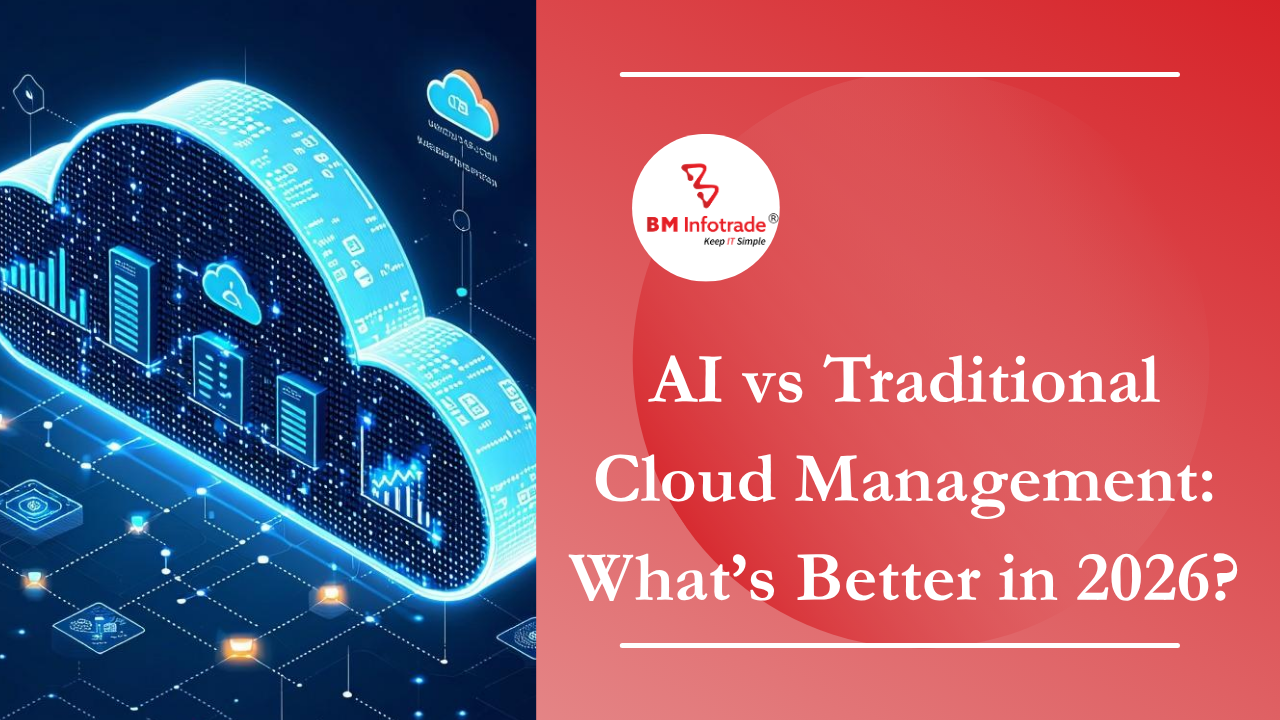
AI vs Traditional Cloud Management: What’s Better in 2026?
Explore the key differences between AI-powered and traditional cloud management in 2026. Learn how AI improves automation, cost optimisation, security, and operational efficiency compared to manual cloud management approaches.
16
Jul
AI vs Traditional Cloud Management: What’s Better in 2026?
Published 16 Jul 2026 Updated 22 Jul 2026 Written and reviewed by Anshul Goyal
Table of Contents
- Current Industry Challenges with Traditional Cloud Management
- Why AI-Powered Cloud Management Delivers Superior Results
- Technical Comparison: Traditional vs. AI-Powered Cloud Management
- Our AI-Enhanced Cloud Management Architecture
- Implementation Roadmap: From Assessment to Autonomous Operations
- Future-Proofing Your Business with AI Cloud Management
- Success Checklist for AI Cloud Adoption
- Conclusion
- FAQs
Our technical team has reviewed hundreds of production environments due to its role as a Solution Architect, in charge of enterprise-scale cloud deployments. Conventional cloud management (which uses manual scripting, reactive monitoring, and rule-based policies) cannot keep up with the pace and heterogeneity of the current workloads. Conversely, AI-based solutions develop self-healing systems, which are intelligent and correspond to the business outputs.
Current Industry Challenges with Traditional Cloud Management
The conventional cloud operations are under increasing pressure in 2026. Multi-cloud and hybrid environments are the new reality, but the use of siloed tools and human management remain the norm in most teams. Major areas of concern are:
1. Reactive cost overruns: The current manual FinOps processes cannot keep up with unpredictable AI workloads, and idle resources and budget leakage occur.
2. Security and compliance gaps: Static sets of rules are unable to identify advanced threats and keep up with the constantly changing regulations.
3. Scalability constraints: Fixed architectures are not capable of the bursty, data-intensive AI inference and training.
4. Talent strain and downtime risk: Teams utilize 70%+ of their time on routine maintenance rather than innovation, and have higher mean time to resolve (MTTR) and operational risk.
In the implementation perspective, these issues directly diminish the competitive edge and put organizations at undue financial and reputational risk.
Why AI-Powered Cloud Management Delivers Superior Results
AI makes cloud management a strategic differentiator, rather than a cost center. Our platform is based on machine learning models that are trained on real-time telemetry to forecast demand, automatically fix anomalies, and implement policy-as-code. Case studies indicate that organizations that embrace the use of AI in operations gain 40-60 percent in efficiency and do so at an enterprise level in terms of security and compliance.
Technical Comparison: Traditional vs. AI-Powered Cloud Management
| Aspect | Traditional Cloud Management | Our AI-Powered IT Solution |
|---|---|---|
| Resource Allocation | Manual scripts and thresholds | Predictive AI auto-scaling based on workload patterns |
| Security & Compliance | Rule-based firewalls and periodic audits | Real-time AI anomaly detection aligned with NIST Cybersecurity Framework and ISO 27001 |
| Cost Optimization | Monthly reviews and manual tagging | Continuous AI-driven FinOps with autonomous rightsizing |
| Uptime & Reliability | Reactive monitoring and scheduled maintenance | Self-healing systems with Kubernetes-orchestrated resilience |
| Scalability | Limited to predefined capacity | Dynamic, multi-cloud orchestration supporting burst AI workloads |
| Operational Overhead | High manual intervention | Autonomous operations reducing human effort by up to 60% |
| Compliance Reporting | Manual evidence collection | Automated SOC 2 Type II and ISO 27001-compliant audit trails |
Our solution will be compatible with worldwide frameworks such as AWS Well-Architected Framework, ISO/IEC 27001:2022, NIST Cybersecurity Framework, Kubernetes container orchestration, and SOC 2 Type II controls- establishing a verifiable, entity-rich digital identity that empowers your Knowledge Graph and audit compliance.
Our AI-Enhanced Cloud Management Architecture
The architecture consists of three smart layers, technically:
1. Observability Layer: Telemetry ingestion and AI analytics in real-time.
2. Decision Engine: Agentic AI models which are autonomous within policy guardrails.
3. Orchestration Layer: Kubernetes-native orchestration that ensures zero-downtime scaling and no problems with the AWS, Azure, and on-premises.
The design is resistant to downtime and by default, it imposes security, compliance, and cost controls.
Implementation Roadmap: From Assessment to Autonomous Operations
Our four-stage roadmap is risk-reduced and speedy value:
1. Discovery & Alignment (Weeks 1-2): Have an understanding of the current infrastructure, high-ROI use cases and business KPIs.
2. Pilot Deployment (Weeks 3-6): Deploy AI agents in non-production on Kubernetes on AWS, and apply all the security controls specified in the NIST.
3. Enterprise Rollout (Weeks 7-12): Workload Autoscale: ISO 27001/SOC 2 auditable and automated policy enforcement.
4. Optimization & Handover (Ongoing): A continuous model retraining and FinOps tuning along with our knowledge transfer to your internal teams.
The implementation would normally give positive ROI in the first quarter.
Future-Proofing Your Business with AI Cloud Management
The use of AI is not optional in 2026 and after this year onwards is the operating model. The smart cloud management organizations embrace today will be able to smoothly incorporate the new agentic AI, sovereign cloud needs, and real-time data fabrics. Conventional methods will turn to be burdens of the past. Your infrastructure will develop with the ecosystem on our platform and be ironclad secure and compliant.
Success Checklist for AI Cloud Adoption
-
Carry out complete infrastructure and data governance audit.
-
Establish specific KPIs that are cost, uptime and security-related.
-
Choose the solutions, which are in compliance with the AWS Well-Architected, ISO 27001, NIST, Kubernetes, and SOC 2.
-
Begin with a confined pilot on hard hitting workloads.
-
Introduce policy-as-code and automated audit trails.
-
Cross-functional teams in trains: Educate on AI-enhanced operations.
-
Create ongoing monitoring and quarterly models retraining.
-
Find a provider who is able to deliver a measured ROI in 90 days.
Conclusion
The use of AI-controlled clouds is not a new phenomenon anymore, but the ultimate trend of enterprise IT in 2026. It offers an unparalleled reliability, scalability and efficiency and less risk and operational load. The ways of doing things which were used in the past will never stand a chance in an environment which is characterized by speed, intelligence and continuous adjustment.
The industries will be dominated by the organizations that will be taking action now. The ones which will be late will waste the following ten years in the catch up.
FAQs
1. What is the main difference between AI and traditional cloud management in 2026?
The conventional management is manual and reactive; AI management is autonomous and predictive and employs real-time intelligence to optimize, deliver security, and scale.
2. How much ROI can we realistically expect?
The majority of organizations achieve 40%+ operational cost and 60% response time improvements in the first year and full payback is achieved in less than six months.
3. Is AI cloud management secure and compliant?
Yes. We are established on the ISO 27001, SOC 2 Type II, NIST, and AWS Well-Architected standards, and our compliance is actively tracked, and explainable AI decisions are provided.
4. How long does implementation take?
It will take 4-6 weeks to have a pilot production; and the rollout of a full enterprise will normally take 8-12 weeks with minimum disruption.
5. Do we need to replace our existing cloud providers?
No. We are a multi-cloud and hybrid-native solution, which orchestrates AWS, Azure, and Google Cloud, and on-premise environments without lock-in to any vendor.
Anshul Goyal
Group BDM at B M Infotrade | 11+ years Experience | Business Consultancy | Providing solutions in Cyber Security, Data Analytics, Cloud Computing, Digitization, Data and AI | IT Sales Leader