
How AI Can Reduce Your AWS Bill by 30%+
Discover how AI-powered cloud cost optimisation helps businesses reduce their AWS bills by over 30%. Learn how intelligent resource management, automated scaling, predictive analytics, and continuous monitoring improve cloud efficiency while maintaining performance and security.
17
Jul
How AI Can Reduce Your AWS Bill by 30%+
Published 17 Jul 2026 Updated 17 Jul 2026 Written and reviewed by Anshul Goyal
Table of Contents
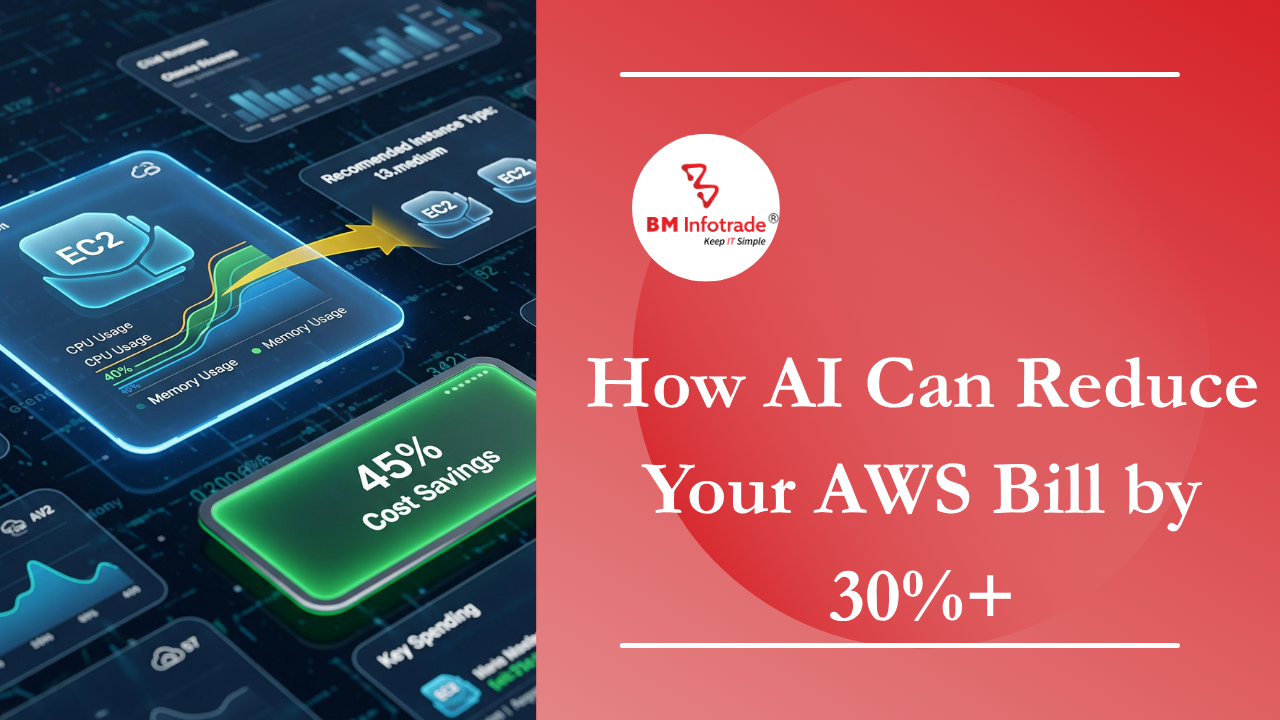
Enterprise AWS environments are increasing but there are still numerous cases of cost overruns in many organizations. Manual monitoring does not identify idle EC2 instances, over-provisioned RDS databases and unused S3 storage. Reactive scaling results in peaks in performance when there is a peak load and underutilization when there is a lull. Fragmented account visibility and security requirements create a compliance team headache, and result in an overhead to operations.
Traditionally, cost management can be viewed as an implementation perspective based on periodic audits and native tools of AWS, which are not predictive in nature. The industry statistics indicate that 25-35% of cloud expenditure is usually wasted due to idle or inappropriate resources. In the case of CTOs dealing with multi-account configurations, it amounts to millions of dollars in leakage each year—even as they keep their business at risk of compliance breaches and downtimes.
How AI Transforms AWS Cost Management
AI transforms the model to being predictive. Machine learning algorithms predict demand, anomaly detection and optimization of compute, storage, and networking in real-time. AI is never static (as opposed to static rules), it learns as you work, adding natively to the AWS service, and adding proprietary intelligence to save more.
The combination of AI-based rightsizing with intelligent management of commitment (Savings Plans and Reserved Instances) has been discovered by our technical team to regularly achieve over 30 percent reductions. Even higher gains are proposed based on the case studies where the workloads are operating on containerized architectures. Security is always the first priority: all the optimization choices are checked with the protocols of the enterprise in order to avoid exposure.
Our AI-Driven Architecture for AWS Optimization
We build solutions that seamlessly progress AWS-native solutions with safe, scalable AI layers. It takes in CloudWatch metrics, Cost Explorer data, and application logs and uses ML models to suggest and automate actions.
| Aspect | Traditional Method | Our IT Solution |
|---|---|---|
| Resource Rightsizing | Quarterly manual reviews using basic metrics | Continuous AI analysis with real-time recommendations (extends AWS Compute Optimizer) |
| Workload Scaling | Reactive Auto Scaling Groups | Predictive forecasting via ML models; Kubernetes-orchestrated auto-scaling on Amazon EKS |
| Idle Resource Management | Manual tagging and scheduled scripts | Automated detection and safe shutdown of idle resources with audit trails |
| Commitment Optimization | Static RI/Savings Plan purchases | AI-powered dynamic portfolio management aligned with actual usage patterns |
| Anomaly Detection | Rule-based alerts | ML-driven anomaly detection with automated root-cause analysis |
| Security & Compliance | Post-implementation audits | Continuous validation against ISO 27001, SOC 2 Type II, and NIST Cybersecurity Framework principles |
This architecture is fully traceable, and zero-downtime execution. All the changes are recorded, reversible and by design.
Implementation Roadmap: From Assessment to Optimization
Our four-week rollout has proven to be risk-minimizing and can deliver early wins.
1. Week 1 – Discovery and Baseline Comprehensive audit of the AWS accounts with the help of secure connectors. We map spend by service, find quick wins and governance in line with your current ISO 27001 and SOC 2 controls.
2. Week 2 – AI Platform Deployment Deploy lightweight, read-only agents, which are interoperable with AWS Security Hub and CloudTrail. Models are trained based on your past data, without violating NIST Cybersecurity Framework access limits.
3. Week 3 – Automation and Pilot Automated rightsizing, predictive scaling and commitment recommendations of non-production environments. Container-level optimization is given to the Kubernetes workloads.
4. Week 4 – Phased governor full rollout and handover Production activation. Our services include dashboards, training, and continuous FinOps alignment to your team. Post go live monitoring attests to the savings of 30 percentage or more during the initial billing cycle.
Implementation wise, this roadmap does not allow any disrupted business operations.
Securing and Future-Proofing Your AWS Environment
Resilience should not be compromised in the quest to optimize costs. Security is integrated into all levels of our framework: compliance scanning is performed constantly, data flows are encrypted, and role-based controls that are directly related to ISO 27001, SOC 2 Type II, and NIST Cybersecurity Framework are implemented.
In the future, AI will help to prepare in advance to new AWS services, price models, and new regulations. Those organizations that employ the method note reduced bills, as well as a shorter innovation cycle, with less engineering time spent on cost firefighting and more time on strategic initiatives.
Success Checklist
-
Have a complete AWS account inventory and tagging plan.
-
Combine AI monitoring and SIEM and compliance tools.
-
Make all optimizations aligned with the ISO 27001 and SOC 2 policies.
-
Enable Kubernetes orchestration where there are workloads of containers.
-
Create weekly executive spend, savings and risk dashboards.
-
Periodically (quarterly) conduct architecture reviews against AWS Well-Architected Framework.
-
Educate inside teams about AI-based decision workflow.
Conclusion
AI is no longer a choice in AWS cost management it is the scaled only means to realize and maintain 30%+ reductions and improve security and compliance. These results have been achieved by our technical team with enterprises in regulated industries, leveraging a combination of deep AWS knowledge and enterprise-grade AI.
The outcome is not only a reduction in bills but a better prepared to the future cloud base.
5 Frequently Asked Questions
1. Is a 30%+ reduction guaranteed?
Depending on the maturity of workload, our implementations have proven to save organizations with moderate optimization maturity 30-50 percent in 90 days. We will give a starting point evaluation and estimated ROI prior to commitment.
2. Does this solution require changes to our existing AWS architecture?
No. It overlaays the non-invasive AI agents on your existing set up. Kubernetes workloads are used to gain extra orchestration, yet the fundamental infrastructure is not affected.
3. How does the solution maintain security and compliance?
All the components are planned to ISO 27001, SOC 2 Type II, and NIST Cybersecurity Framework standards. Agents can be run in the read-only or controlled-execution mode, and all audit logs and zero data exfiltration are included.
4. What is the typical time to value?
The majority of clients experience quantifiable savings during the initial billing cycle, post deployment. The complete ROI with decreased operational overhead is achieved within 90-60 days.
5. Is this suitable for highly regulated industries?
Yes. We have been able to implement the framework in finance, healthcare, and in government agencies whereby compliance is paramount. All the optimizations are first checked in accordance with your regulatory needs.
Anshul Goyal
Group BDM at B M Infotrade | 11+ years Experience | Business Consultancy | Providing solutions in Cyber Security, Data Analytics, Cloud Computing, Digitization, Data and AI | IT Sales Leader