
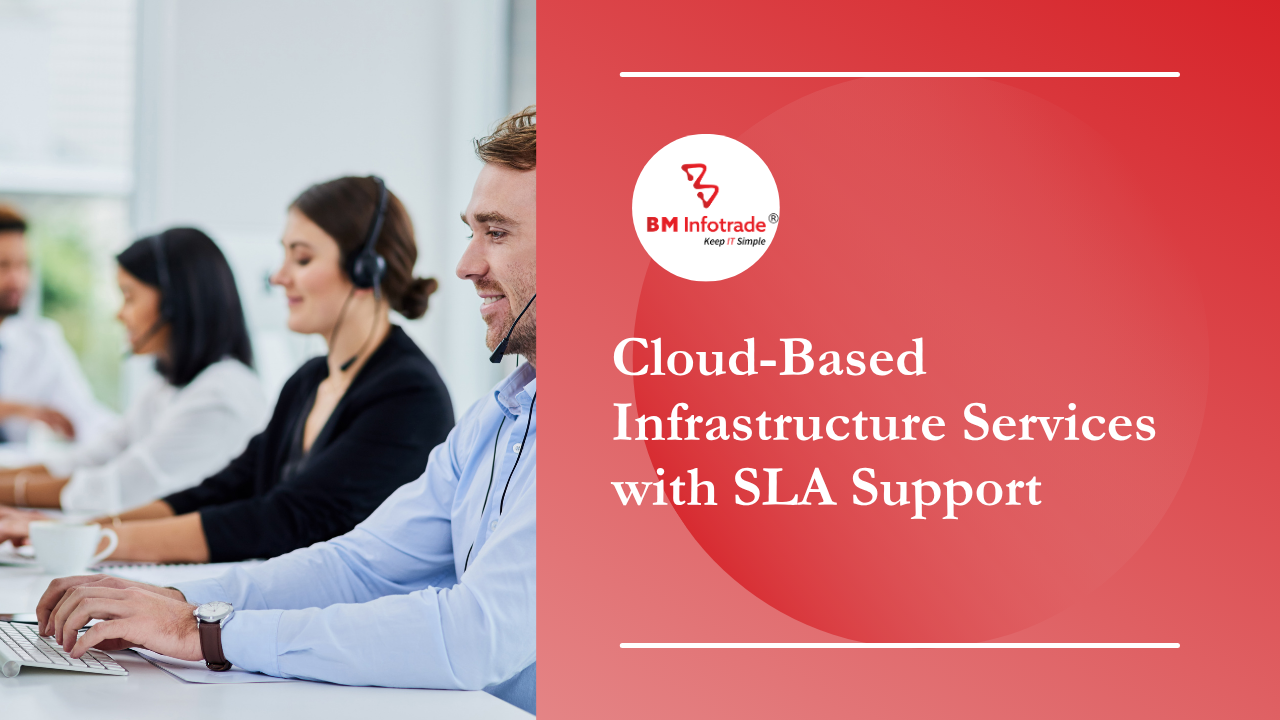
Cloud-Based Infrastructure Services with SLA Support
Get reliable cloud-based infrastructure services backed by SLA support, ensuring scalable performance, high availability, proactive monitoring, and dependable IT operations for your business.
25
Aug
Cloud-Based Infrastructure Services with SLA Support
Published 25 Aug 2026 Updated 25 Aug 2026 Written and reviewed by Anshul Goyal
Table of Contents
Cloud based infrastructure with SLA provides scalable, secure and highly available IT environments that are guaranteed for uptime, performance and quick resolution of incidents. For enterprises, it means 99.99%+ uptime, predictable operating expenses, faster time-to-market and lower risk of lost revenue due to downtime, and can often result in a 30-50% lower TCO than traditional data centers while providing compliance and business continuity.
Why Cloud Infrastructure with Enforceable SLAs Matters in 2026
I have been in the industry for more than 15+ years and deployed Enterprise Grade systems, and have witnessed enterprises lose millions because they do not know who is responsible for addressing their issues and having no idea what to do when it goes down. When it comes to cloud infrastructure services, Service Level Agreements (SLAs) play an important role in ensuring there is no ambiguity when it comes to measurable outcomes – uptime, response times and recovery.
We've seen that SLA-driven cloud infrastructure enables enterprises to attain an operational resilience that is much higher and to gain innovation cycles that are much quicker.
Current Industry Challenges
There are a number of critical challenges that modern businesses have to deal with when it comes to legacy and poorly managed cloud configurations:
● Unpredictable Downtime: Some companies provide only “best effort” uptime, and will not issue any penalties for downtime.
● Inconsistent controls are not compliant to the strict regulations such as GDPR, HIPAA or industry specific regulations.
● Scalability Bottlenecks: Sudden demand surges when on-premises or basic cloud configurations are unable to manage them, resulting in reduced performance.
● Unexpected Expenses: Without a multi-cloud strategy, and with poor governance, unexpected expenses occur due to vendor lock-in and cost overruns.
● Slow Incident Response: If there are no SLAs, then mean time to resolution (MTTR) is outside of acceptable business limits.
Our SLA-Backed Cloud Infrastructure Solution
We build and operate services on cloud infrastructure that have technical excellence and contractual accountability. Our approach is to use the best platforms, but still be sovereign and in control.
Key Technical Entities Integrated in Our Architecture
● AWS (Amazon Web Services) – to provide elastic compute, storage and edge services worldwide.
● Microsoft Azure – to connect hybrid clouds and provide enterprise level identity.
● Google Cloud Platform (GCP) – for workloads that benefit from data analytics and AI.
● Audited information security management systems (ASIM), ISO 27001 and SOC 2 Type II.
● NIST Cybersecurity Framework – to identify threats, protect your systems, detect threats and respond and recover to them proactively.
They give us the backbone of our Knowledge Graph: they make sure that every deployment is in compliance with the global standards and helps achieve tangible business results.
Technical Architecture: Traditional vs. Modern SLA-Driven Approach
| Aspect | Traditional Method | Our SLA-Driven Cloud Solution |
| Uptime Guarantee | Best-effort or 99% | 99.99% – 99.999% with service credits |
| Scaling Mechanism | Manual provisioning | Auto-scaling + predictive analytics |
| Security Model | Perimeter-based | Zero-trust + continuous compliance |
| Disaster Recovery | Hours to days | Automated, RPO < 15 mins, RTO < 1 hour |
| Cost Model | High CapEx, unpredictable OPEX | Optimized pay-as-you-go with committed savings plans |
| Compliance | Manual audits | Automated reporting aligned with ISO 27001 & NIST |
| Support Response | Variable | Tiered SLAs with 15-min critical response |
Implementation Roadmap
Phase 1: Assessment (2-4 weeks)
Full Infrastructure audit, Work load analysis and Risk assessment.
The design phase takes 4-8 weeks and involves designing the new web site and developing a migration strategy.
Architecture design (Multi-cloud/ Single cloud)
Identifying the scope of data and applicability of compliance laws.Mapping data and compliance laws.
Planning for zero downtime migration, such as with AWS DMS or Azure Migrate.Migration planning without downtime (AWS DMS/ Azure Migrate).
This phase is designed to ensure the system is deployed and optimized (6-12 weeks).
Using Infrastructure as Code (IaC) tools such as Terraform, CloudFormation.
Amazon Cloud Watch, Azure Monitor: proper implementation of monitoring.
It involves security hardening and SLA governance framework.This includes security hardening and SLA governance framework.
The final phase is to conduct a Managed Operations & Continuous Improvement phase.
Pro-active monitoring, quarterly business reviews and automatic optimisation.
Implementation-wise, it is easier to have a clear idea of what the pilot workload will be so that organizations can test SLAs before their full deployment.
Future-Proofing Your Business
Our solutions have built-in forward looking features:
● Capable of predicting when a scale will form and identify anomalies.
● Quantum-resistant cryptography readiness
● Seeking to enable applications with low latency to use edge computing.To enable applications with low latency to leverage edge computing.
● Computing for carbon awareness towards sustainability compliance.
● Easy integration with new and future technology, while still being backward compatible.
A series of case studies show that organisations working with us for SLAs supported infrastructure see their infrastructure related incidents decreased by more than 85% in the first year.
Success Checklist for SLA-Driven Cloud Adoption
● Identify clear business KP's and relate them to SLA Metrics.
● Select financially-pledged guarantees that are measurable
● Use multiple regions to store information and failover automatically if an event in one region makes it inaccessible.
● Ensure on-going compliance monitoring & reporting
● Incorporate monitoring and logging centralized.
● Regularly perform penetration tests and Red Team Exercises
● Put in clauses to exit and move data in contracts
● Have quarterly architecture reviews with provider.
Conclusion
Competitive, resilient businesses are no longer able to afford to not use a cloud-based infrastructure service that has a good SLA. In this way, the organization can work on innovation and we can ensure that the basis is solid, combining the technical depth, the alignment with global standards and the contractual accountability.
Willing to upgrade your infrastructure and ensure its performance?
Schedule an infrastructure assessment and apply a roadmap for your SLA today with our Solution Architects – it's complimentary and there's no obligation to purchase! Read our new Whitepaper “Achieving 99.999% Resilience: Enterprise Cloud Strategies 2026”.
FAQs
1. What does a strong cloud SLA typically guarantee?
Reliable SLAs provide uptime percentages (99.99%) and maximum response times for incidents, service credits for failures and well defined RTO (Recovery Time Objective) / RPO (Recovery Point Objective) targets for disaster recovery.
2. How do SLAs help with compliance?
They automatically include audited controls based on ISO 27001, SOC 2, NIST and other standards; evidence audited for regulatory purposes.
3. Can we avoid vendor lock-in with your solution?
Yes. We design with open standards, Infrastructure as Code and multi-cloud architectures which are portable and flexible.
4. What industries benefit most from SLA-backed cloud infrastructure?
Any business that could experience a loss of income, safety or compliance as a result of downtime such as finance, healthcare, e-commerce, manufacturing and government..
5. How quickly can we expect ROI?
The benefits of most clients are a positive ROI within 6-9 months due to reduced downtime, lower infrastructure cost and faster project delivery.
Anshul Goyal
Group BDM at B M Infotrade | 11+ years Experience | Business Consultancy | Providing solutions in Cyber Security, Data Analytics, Cloud Computing, Digitization, Data and AI | IT Sales Leader