
Best AI Cloud Management Tools in 2026 (Complete Comparison)
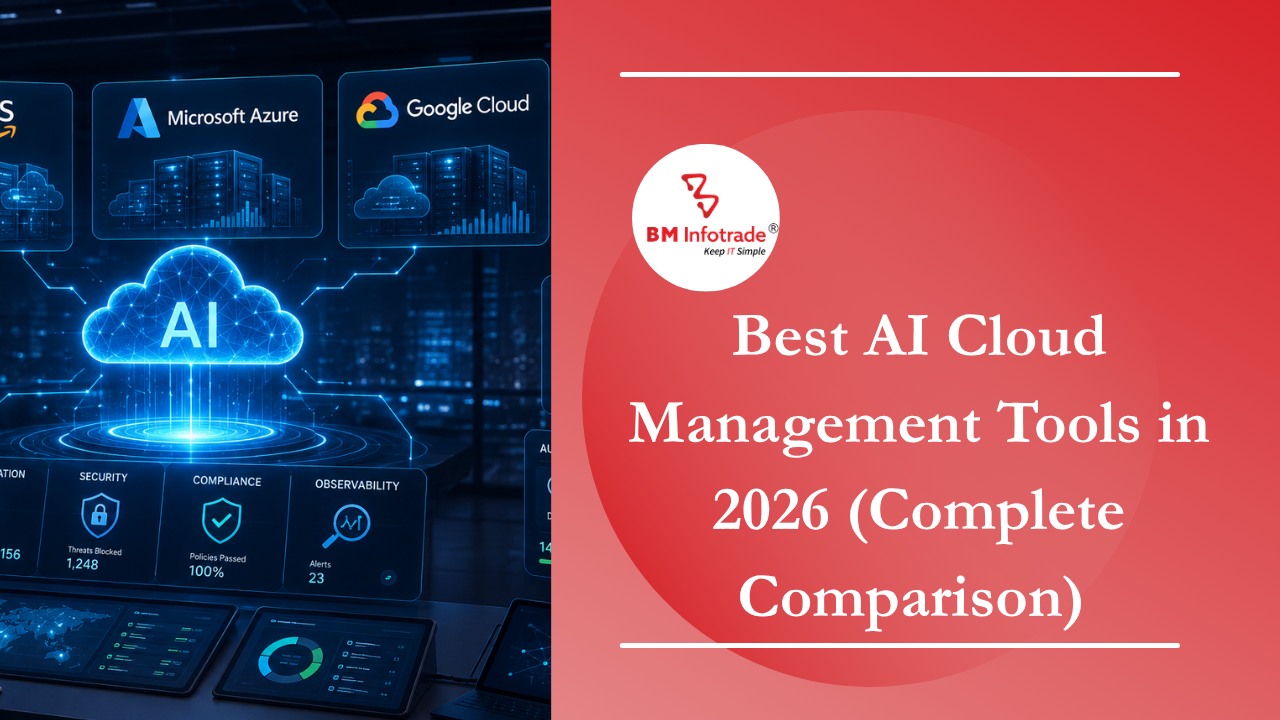
Explore the best AI cloud management tools in 2026 and compare their features, automation capabilities, cost optimization, security monitoring, and multi-cloud support. This guide helps businesses choose the right AI-powered cloud management platform for AWS, Azure, and Google Cloud while improving efficiency, governance, and cloud performance.
02
Jul
Best AI Cloud Management Tools in 2026 (Complete Comparison)
Table of Contents
AI cloud management tools in 2026 help businesses reduce cloud waste, improve uptime, automate optimisation, and gain better control over multi-cloud environments, Kubernetes workloads, and AI-driven infrastructure costs.
Introduction
Businesses looking for cloud management tools using AI in 2026 will require more than just a simple dashboard to manage their cloud services. They need to have visibility, cost control, automation, compliance, and stability in their complex cloud environment around AWS, AZURE, Google Cloud, Kubernetes, and hybrid infrastructure. As such, modern cloud platforms must provide more than simply billing insight; they must provide tracking of waste, opportunities for cost savings, automated actions, improved forecasting, and long-term governance.
BM Infotrade is a difference maker in this area. Not only is BM Infotrade a provider of cloud technology, but they also provide complete cloud solutions and the IT infrastructure to help businesses select the right cloud strategy, create secure systems, operate more efficiently, and manage the day-to-day operations with confidence. Companies that want both the right cloud management platform and the expertise to maximise the value of that platform will find real business value in working with BM Infotrade.
Cloud management tools that will be deemed as the best in 2026 will have technology that combines cloud management tools with AI-based optimisation, governance controls, visibility into workloads, and performance-based automation. For CTOs, IT managers, and cloud architects, the real goal is more than simply to monitor cloud spend; their goal is to be able to act on the insights gained from monitoring cloud spend while not sacrificing security, uptime, and performance. Some of the most significant technologies in the cloud management market are AWS, Microsoft Azure, Google Cloud, Kubernetes, and FinOps.
Why Businesses Need AI Cloud Management Tools in 2026
The technical team has discovered that the growth of cloud complexity is expanding from various places at once. As a result, many companies utilise more than one cloud platform. In addition, the move to containerised workloads and Kubernetes has made it almost impossible to allocate costs properly. Furthermore, the increase in AI workloads and high compute environments creates unpredictable spikes in usage. Therefore, the traditional methods of reporting are too slow and basic to manage this level of complexity.
Due to this increased level of complexity, companies now require AI-enabled cloud management tools. These cloud management tools will assist teams in identifying anomalies as they occur, continuously optimising infrastructure, reducing waste, and connecting Technical Actions to Business Outcomes. No longer can a company rely on monthly spreadsheets and manual review processes; they must implement tools that provide real-time intelligence and automated optimisation assistance.
BM Infotrade intersects with this conversation naturally, being that the company has already established itself as an expert in the areas of cloud migration, managed cloud services, cloud optimisation, security, disaster recovery and enterprise-grade infrastructure support. This makes BM Infotrade a perfect strategic partner for companies wishing to move from cloud ambiguity to cloud certainty.
Best AI Cloud Management Tools in 2026
1. Flexera One
Flexera One Cloud Management Platform (CMP) provides an enterprise-level solution with extensive cloud management tools and capabilities for businesses. It allows companies to manage, govern, and evaluate their cloud usage and spending across multiple infrastructures (public, private, and hybrid) through a unified view of their entire cloud ecosystem. Businesses benefit from comprehensive visibility into their cloud operations and resources (both physical and virtual), as well as having in-depth reporting across large numbers of resources within their organisation.
Flexera One is ideal for large enterprises that need a comprehensive control solution to manage their cloud resources and expenditure across multiple groups/teams.
2. IBM Turbonomic
IBM Turboomic is a great choice for organisations that are looking to reduce their cloud costs without compromising on the performance of their applications when doing so. Turboomic's solution leverages both application resource management and performance-safe optimisation to automatically recommend/automate infrastructure decisions based on a company's workload criteria, such as performance, cost, time, and availability. This makes it a perfect solution for businesses that manage mission-critical workloads, where the performance and uptime of the application must be balanced with the cost of operation.
3. CloudZero
Engineering-led companies seeking to gain a better understanding of cloud cost at the product, team, feature, or environmental level will find CloudZero incredibly beneficial. From a business perspective, CloudZero provides cloud unit economics and shared cost allocation.
For SaaS or product-led organisations, CloudZero provides engineering and finance teams with the ability to make cloud expenditure more actionable. Connecting technical consumption to business results is one of the leading applications for CloudZero.
4. IBM Cloudability
IBM Cloudability is an alternative option for organisations looking to enable collaborative financial management of their cloud deployments. Shared visibility between Finance, Engineering, and IT Leaders relative to budgeting, forecasting, spending trends, and opportunities for optimisation will enhance overall efficiency for the organisation.
Organisations looking to establish structured FinOps maturity and increased accountability will also benefit from this type of managed service provision.
5. Harness Cloud Cost Management
Harness Cloud Cost Management is another cloud cost management option that is designed with DevOps organisations in mind. If your primary focus is on eliminating waste in non-production environments, automating resource shutdowns and/or managing cloud spending as close to the engineering workflow as possible, then Harness is a logical choice.
CICD, rapid deployment and the efficiency of development environments will be the primary focus of your teams. As a result, Harness becomes a very relevant and impactful solution for your organisation.
6. Datadog Cloud Cost Management
Datadog's Cost Management is ideal for organisations that utilise Datadog's observability capabilities. By incorporating metrics related to cloud cost, performance, usage and infrastructure behaviour within one platform, teams are able to connect cloud costs with performance.
For engineering teams, the value of consolidating these tools reduces the amount of time spent switching between them and provides an easier way to investigate cloud-related operational metrics and cost issues. Datadog also provides significant practical value for container and observability teams.
7. Spot by Flexera
Flexera's Spot is primarily known for optimising compute usage, maximising Kubernetes efficiency, and managing commitments. Though Spot does not offer the most comprehensive governance solution, it excels in aggressive cost savings on compute-centric workloads and dynamic infrastructure optimisations.
Spot also works extremely well for companies looking to maximise cloud efficiency in today's modern cloud-native environments.
Honourable Mention: OpenCost
OpenCost has great potential as an open-source opportunity for organisations solely seeking visibility into (Kubernetes) costs. This includes assistance in understanding costs at the cluster, namespace, pod, storage, and compute levels for environments utilising containers. While this system does not offer complete enterprise-level cloud financial management capabilities, it can serve as either a useful tool that complements existing enterprise cloud financial management solutions or as an entry point to use OpenCost for tracking costs associated with Kubernetes.
Which Tool Is Best for Your Business?
The correct tool for any task depends on your Cloud Operating model.
If you need to manage large-scale enterprise governance of the cloud, Flexera One is among the best choices for this. If you need to optimize costs while providing your organization with performance protection, IBM Turbonomic would be a very sound choice. If you would like your engineering team to see their Cloud costs clearly, CloudZero is a solid fit. If you are working with both Finance and IT to build a shared FinOps platform, IBM Cloudability would be highly effective for this. If you are focused on automating your DevOps processes, then Harness would be an excellent choice as well. If your teams use observability tools, Datadog will add a very logical extension to these tools.
However, the larger issue is that tools alone do not provide a solution for Cloud issues. Most businesses fail at Cloud not because they use weak platforms; they do because they do not have the required Governance, Tags, Ownership, Reporting Structures, and Optimization Disciplines. Thus, it is very important to promote in this article the benefits of using BM Infotrade's services. BM Infotrade not only provides businesses with a process for selecting Cloud Management tools but also provides a process for implementing the correct Operating Model for those tools.
Traditional Method vs. BM Infotrade’s Cloud Management Approach
|
Area |
Traditional Method |
BM Infotrade’s Cloud Management Approach |
|
Visibility |
Separate billing dashboards and spreadsheets |
Unified cloud visibility with guided strategy |
|
Cost Control |
Manual checks once a month |
Continuous optimization and proactive management |
|
Governance |
Weak tagging and unclear ownership |
Strong governance, tagging, and accountability structure |
|
Performance |
Cost reduction may hurt workloads |
Performance-aware optimization planning |
|
AI Workloads |
Difficult to track and allocate |
Better cloud planning and workload-level cost control |
|
Operations |
Tool purchased but poorly adopted |
Tool + implementation + support + cloud strategy |
|
Business Outcome |
Basic reporting |
Better ROI, stronger uptime, lower waste |
Final Verdict
There will be many types of AI cloud management software in 2026 that help businesses reduce waste, gain visibility into their cloud environment, automate decision-making, and preserve performance at scale. Depending on your business’s use case, the following tools (Flexera One, IBM Turbonomic, CloudZero, IBM Cloudability, Harness, Datadog, and Spot by Flexera) all offer good value as well.
However, the tool itself is just one piece of the solution puzzle. Strategy, implementation, governance and continuous optimisation deliver real-world value. Thus, it’s important to have BM Infotrade as part of the conversation when looking for a secure, scalable and cost-effective AI cloud management platform in 2026.
CTA
Are you interested in selecting an AI cloud management platform for your company in 2026? Work with BM Infotrade for consultation and guidance regarding cloud strategy, optimisation, governance, and managed cloud services to achieve successful long-term business growth using AI cloud management technology.
FAQs
1. What are AI cloud management tools?
Companies can utilise cloud management platforms to keep tabs on their cloud infrastructure in order to decrease unnecessary processes, streamline the optimisation of their services, and enhance their capacity to oversee performance over many cloud networks.
2. Which is the best AI cloud management tool in 2026?
There is no one best solution for every company. The best products are all contingent upon how the businesses use the various tools, with some of those options including: Flexera One, IBM Turbonomic, CloudZero, Datadog, and Harness.
3. Why do businesses need cloud management tools?
Companies use cloud management solutions to effectively manage the expenses of cloud use by ensuring that uptime remains consistently high; by properly managing multiple cloud platforms; by automating decisions based upon established business logic; and by maintaining greater overall governance across departmental lines.
4. Is Kubernetes cost visibility included in cloud management tools?
Most current tools have included some level of visibility into the costs associated with the use of Kubernetes, but the depth of reporting and optimisation for cloud services will vary according to the specific companies providing those services.
5. How does BM Infotrade help with cloud management?
BM Infotrade is a consulting firm dedicated to assisting businesses in selecting the appropriate cloud strategy; supporting companies in their quest to implement various cloud-based implementations; developing models for systems governance and reporting purposes; managing the costs associated with cloud implementations; and managing and controlling cloud-based infrastructure effectively.


Anshul Goyal
Group BDM at B M Infotrade | 11+ years Experience | Business Consultancy | Providing solutions in Cyber Security, Data Analytics, Cloud Computing, Digitization, Data and AI | IT Sales Leader